consumertop10

Home › Software

Top 10 · Software

Top 10 Data Orchestration Tools

The tools data teams use to schedule, run and monitor data pipelines, ranked by GitHub stars.

Quick answer

Apache Airflow is the most popular data orchestration tool, with 47,488 GitHub stars: it lets you author, schedule and monitor workflows as Python code. Kestra is second with 30,235 stars and builds workflows in declarative YAML, and Prefect is third with 24,159 stars for turning Python scripts into production pipelines. Luigi, Windmill and Argo Workflows follow.

How it's ranked: GitHub stars on each project's official repository, read November 15, 2026. Stars measure developer interest, not paying customers or production use, so treat them as a guide to popularity.

1
Apache Airflow by Apache Software Foundation
Image: Apache Airflow (official site)

Apache Airflow

Apache Software Foundation · Platform to author, schedule and monitor workflows in Python

47,488 GitHub stars

The industry standard for data pipelines.

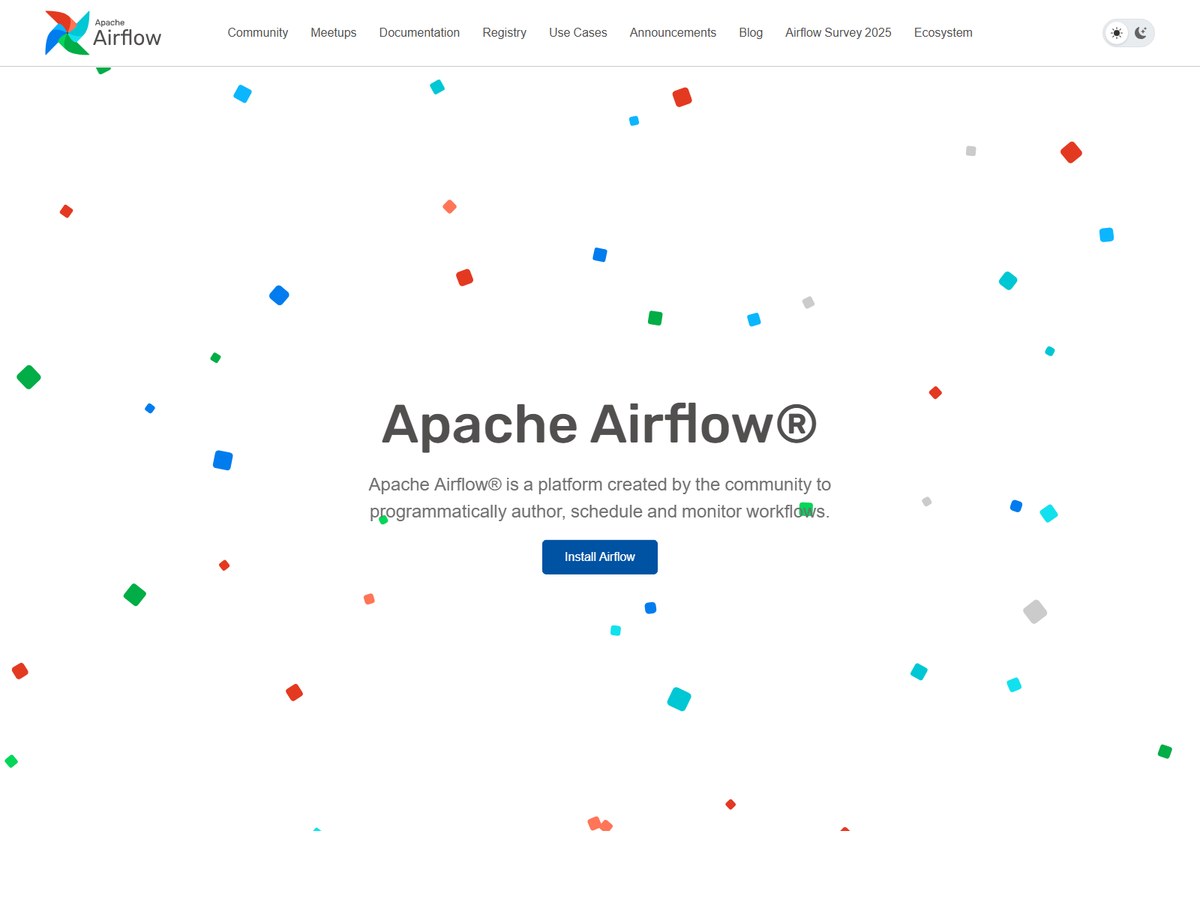
Apache Airflow is the most popular data orchestration tool, with 47,488 GitHub stars. It is a platform to programmatically author, schedule and monitor workflows. You define workflows (Dags) as Python code, which makes them easier to maintain, version, test and share, and the Airflow scheduler runs your tasks on an array of workers while following their dependencies. A rich web UI shows pipelines running in production so you can monitor progress and troubleshoot. Airflow uses the Jinja templating engine and a wide range of built-in operators, and its modular architecture uses a message queue to orchestrate any number of workers. Beyond data pipelines, it is widely used for machine learning and increasingly for AI and LLM workloads. Its README says the project knows of around 500 organizations using Airflow. It is an Apache project under the Apache License 2.0.

Best forData teams that want the industry standard with the biggest ecosystem
Skip it ifYou need streaming or fast-changing, highly dynamic workflows

Source: github.com/apache/airflow
2
Kestra by Kestra
Image: Kestra (official site)

Kestra

Kestra · Event-driven orchestration platform with declarative YAML

30,235 GitHub stars

The most flexible all-rounder.

Kestra has 30,235 GitHub stars, and its homepage celebrates crossing 30,000. It is an open-source, event-driven orchestration platform for data, AI and infrastructure workflows, with the tagline "Orchestrate everything, everywhere." Kestra unifies scheduled and event-driven automation behind a declarative, language-agnostic interface: you build workflows in a few lines of YAML, and the YAML editor, a no-code editor and a built-in AI Copilot all edit the same flow and stay in sync. Workflows stay as code with Git version control, even when built from the UI. Kestra lists 2,600+ plugins to pull data from any database, cloud storage or API and run scripts in any language. AI agents and RAG workflows are first-class task types, and a built-in MCP server exposes your flows as tools to AI agents. It is open source under Apache 2.0.

Best forMixed teams who want workflows in YAML, a no-code editor and any language
Skip it ifYou want pipelines written purely as Python code

Source: github.com/kestra-io/kestra

3
Prefect by Prefect
Image: Prefect (official site)

Prefect

Prefect · Python workflow orchestration framework

24,159 GitHub stars

The easiest path from Python script to pipeline.

Prefect has 24,159 GitHub stars and is a workflow orchestration framework for building data pipelines in Python. Its README calls it the simplest way to elevate a script into a production workflow: you add flow and task decorators to ordinary Python functions, and with a few lines of code you get scheduling, caching, retries and event-based automations. Prefect flows can handle retries, dependencies and complex branching logic, and pipelines can react to events and recover from unexpected changes. You can track and monitor activity on a self-hosted Prefect server or the managed Prefect Cloud dashboard. Prefect requires Python 3.11 or later and is open source under Apache 2.0. Prefect has also grown: Dagster's website says Dagster is now part of Prefect, and Prefect describes Prefect, Dagster and FastMCP as open-source Python frameworks.

Best forPython data teams turning scripts into production workflows
Skip it ifYour team does not work in Python

Source: github.com/PrefectHQ/prefect

4
Luigi by Spotify
Image: Luigi (official GitHub repository)

Luigi

Spotify · Python package for pipelines of batch jobs

18,789 GitHub stars

The simple, battle-tested batch pipeline tool.

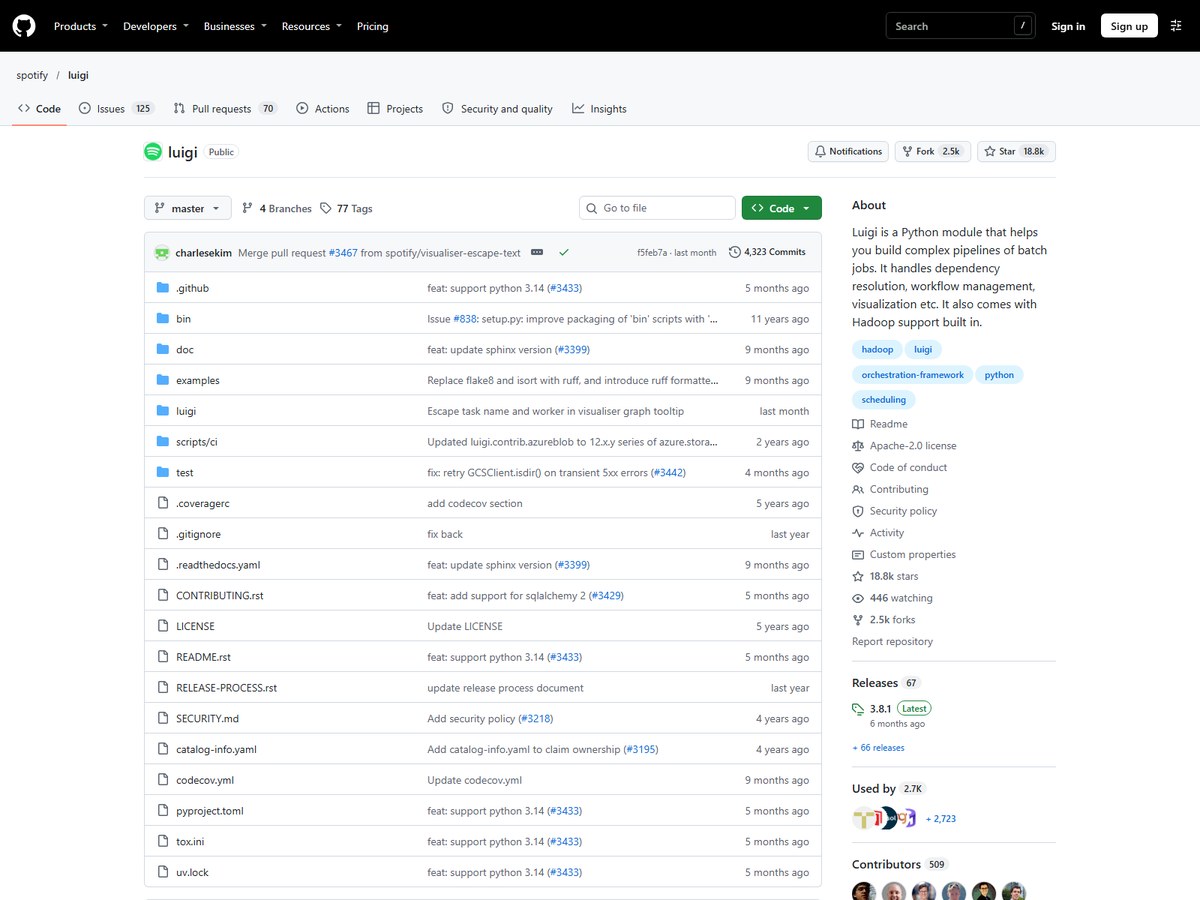
Luigi, created at Spotify, has 18,789 GitHub stars. It is a Python package that helps you build complex pipelines of batch jobs, handling dependency resolution, workflow management, visualization, failure handling and command line integration. Its purpose is to take care of the plumbing around long-running batch processes, where you chain many tasks and failures will happen. Luigi does not replace tools like Hive, Pig or Spark; instead it stitches tasks together, where each task can be a Hive query, a Hadoop job, a Spark job, a Python snippet or a database dump, into pipelines of thousands of tasks that can take days to run. Spotify uses Luigi internally to run thousands of tasks every day, powering recommendations, toplists, A/B test analysis and dashboards. It installs with pip install luigi, is tested on Python 3.10 to 3.14 and is Apache 2.0 licensed.

Best forTeams running long batch jobs who want a simple, proven Python tool
Skip it ifYou want a modern UI, event triggers or a managed cloud service

Source: github.com/spotify/luigi

5
Windmill by Windmill Labs
Image: Windmill (official site)

Windmill

Windmill Labs · Code-first platform for workflows, apps and AI agents

18,601 GitHub stars

Pipelines, scripts and apps in one platform.

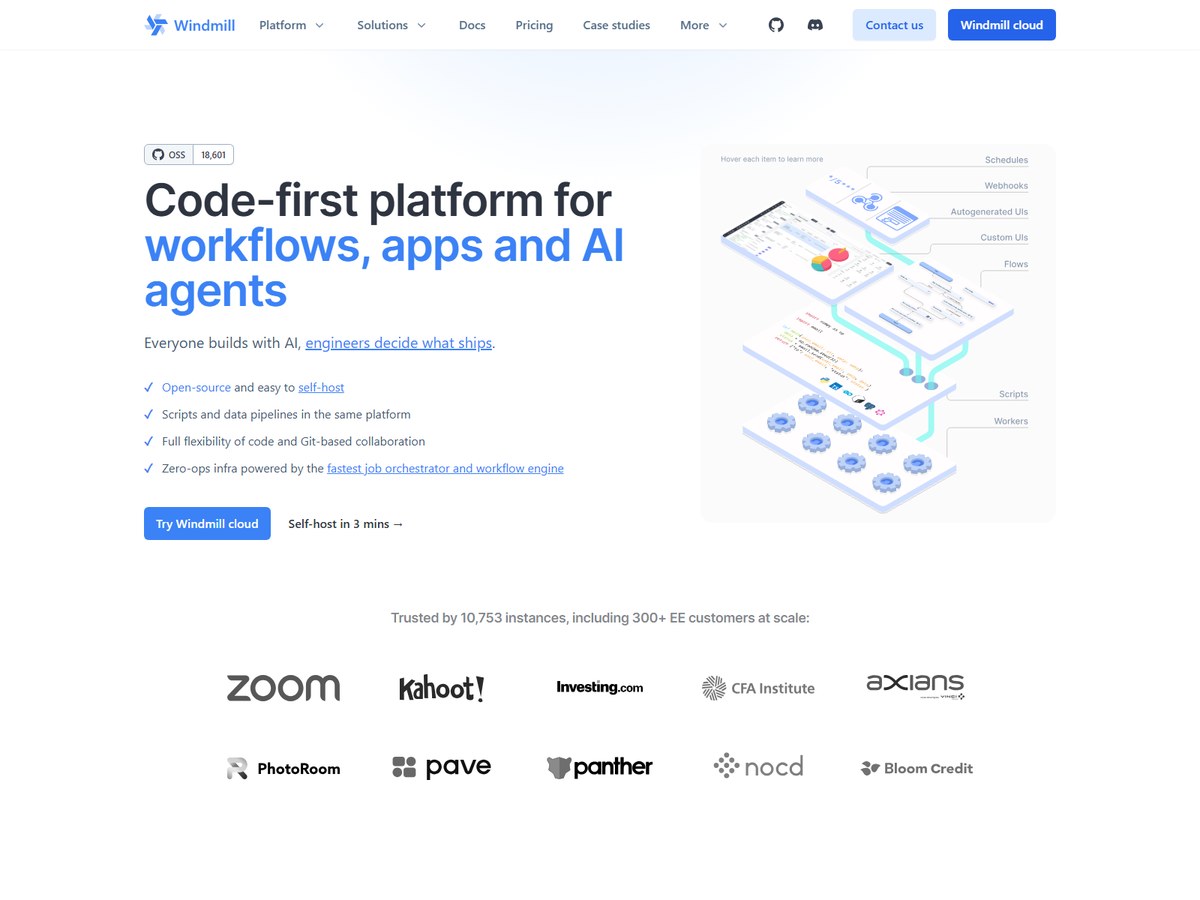
Windmill has 18,601 GitHub stars and is an open-source, self-hostable, code-first platform for workflows, apps and AI agents. Its README says it runs on the fastest self-hostable orchestrator, and its GitHub description says it is benchmarked against Airflow, Prefect and Temporal. Engineers write code in 20+ languages, including Python, TypeScript, Go, Bash, SQL, GraphQL, PowerShell and Rust, and sync it with Git. Windmill turns scripts into sharable UIs, APIs and cron jobs automatically, and you can compose them into flows, data pipelines, AI agents or React and Svelte apps. Business teams can build with AI on the same platform, while review, promotion between environments and isolated workers keep engineers in control. Windmill says it is trusted by 300+ enterprise edition customers at scale. The open-source code is AGPLv3, with commercial licenses from Windmill Labs.

Best forEngineering teams that want scripts, pipelines and internal apps on one platform
Skip it ifYou need a permissive license for embedding the code

Source: github.com/windmill-labs/windmill

6
Argo Workflows by Argo Project (CNCF)
Image: Argo Workflows (official site)

Argo Workflows

Argo Project (CNCF) · Container-native workflow engine for Kubernetes

17,099 GitHub stars

The Kubernetes-native choice.

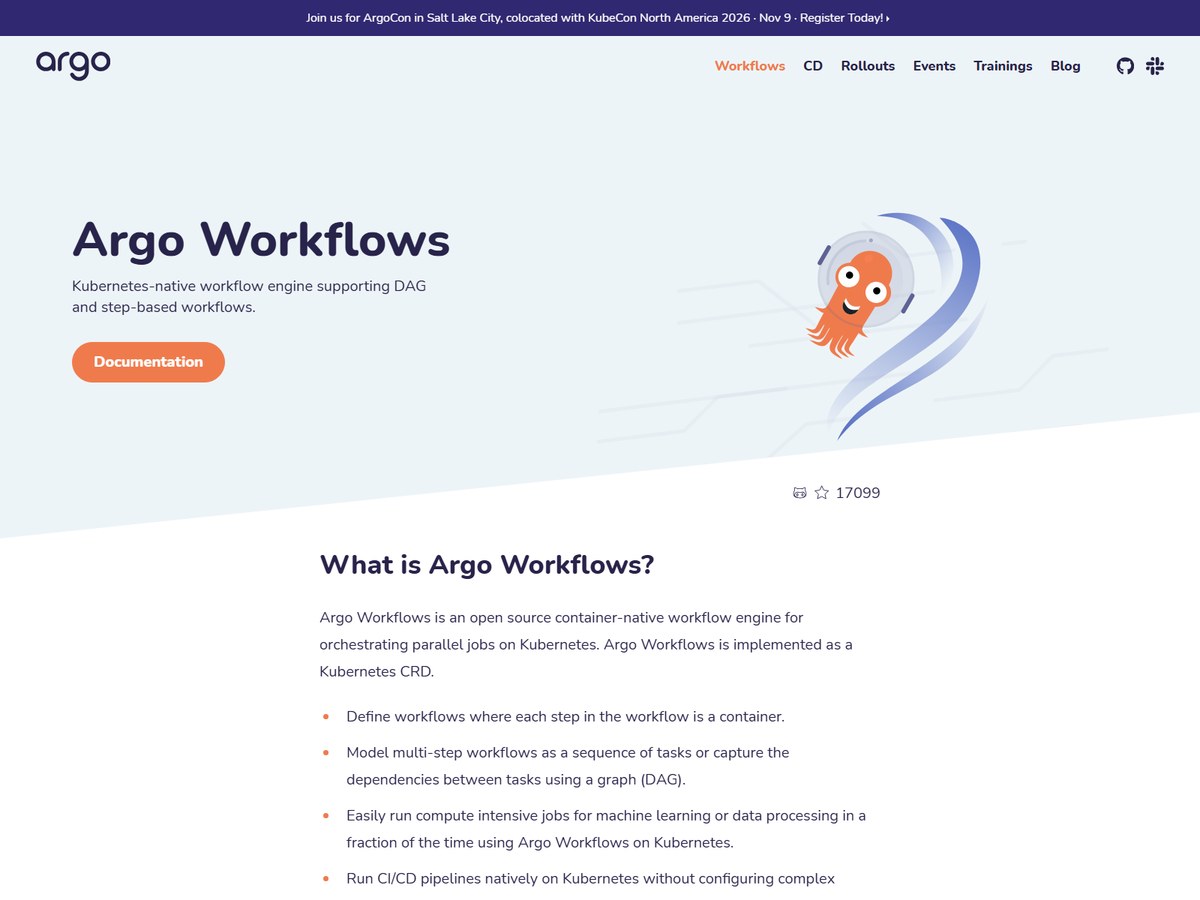
Argo Workflows has 17,099 GitHub stars and is an open-source, container-native workflow engine for orchestrating parallel jobs on Kubernetes. It is built as a Kubernetes Custom Resource Definition: each step in a workflow is a container, and you can model multi-step workflows as a sequence of tasks or as a directed acyclic graph (DAG) of dependencies. Its README calls it the most popular workflow execution engine for Kubernetes and says it can run compute-intensive machine learning or data processing jobs in a fraction of the time. Use cases include ML pipelines, data and batch processing, infrastructure automation and CI/CD. Python users can work through the Hera SDK, and projects that rely on it include Kubeflow Pipelines, Netflix Metaflow and Kedro. About 200+ organizations officially use it. Argo is a CNCF graduated project, licensed Apache 2.0.

Best forKubernetes teams running ML, data and batch jobs in containers
Skip it ifYou do not run Kubernetes

Source: github.com/argoproj/argo-workflows

7
Dagster by Dagster (now part of Prefect)
Image: Dagster (official site)

Dagster

Dagster (now part of Prefect) · Data pipeline orchestrator built around data assets

16,425 GitHub stars

Best for asset-centric data teams.

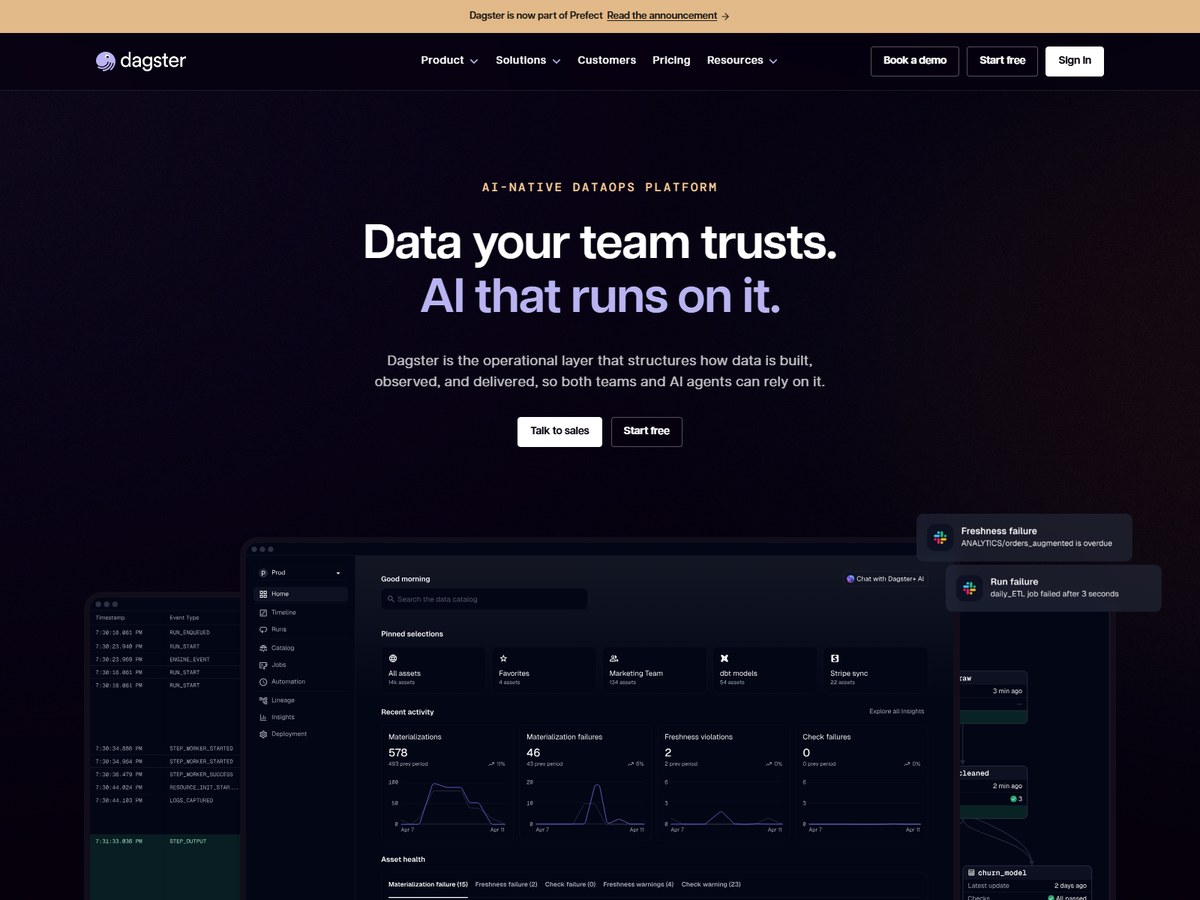
Dagster has 16,425 GitHub stars and is a cloud-native data pipeline orchestrator for the whole development lifecycle, with integrated lineage and observability, a declarative programming model and strong testability. Its big idea is data assets: instead of wiring up tasks, you declare, as Python functions, the tables, data sets, machine learning models and reports you want to build, and Dagster runs those functions at the right time and keeps the assets up to date. It is built for every stage, from local development and unit tests to staging and production, and its unified control plane centralizes metadata with observability, cataloging and lineage. Dagster supports Python 3.9 through 3.14 and integrates with popular data tools. Note the news on its website: Dagster is now part of Prefect. The open-source code is Apache 2.0.

Best forAnalytics engineers who think in tables, models and reports rather than tasks
Skip it ifYou only need to schedule a few simple scripts

Source: github.com/dagster-io/dagster

8
Apache DolphinScheduler by Apache Software Foundation
Image: Apache DolphinScheduler (official site)

Apache DolphinScheduler

Apache Software Foundation · Low-code data orchestration platform

14,553 GitHub stars

Low-code orchestration at big-data scale.

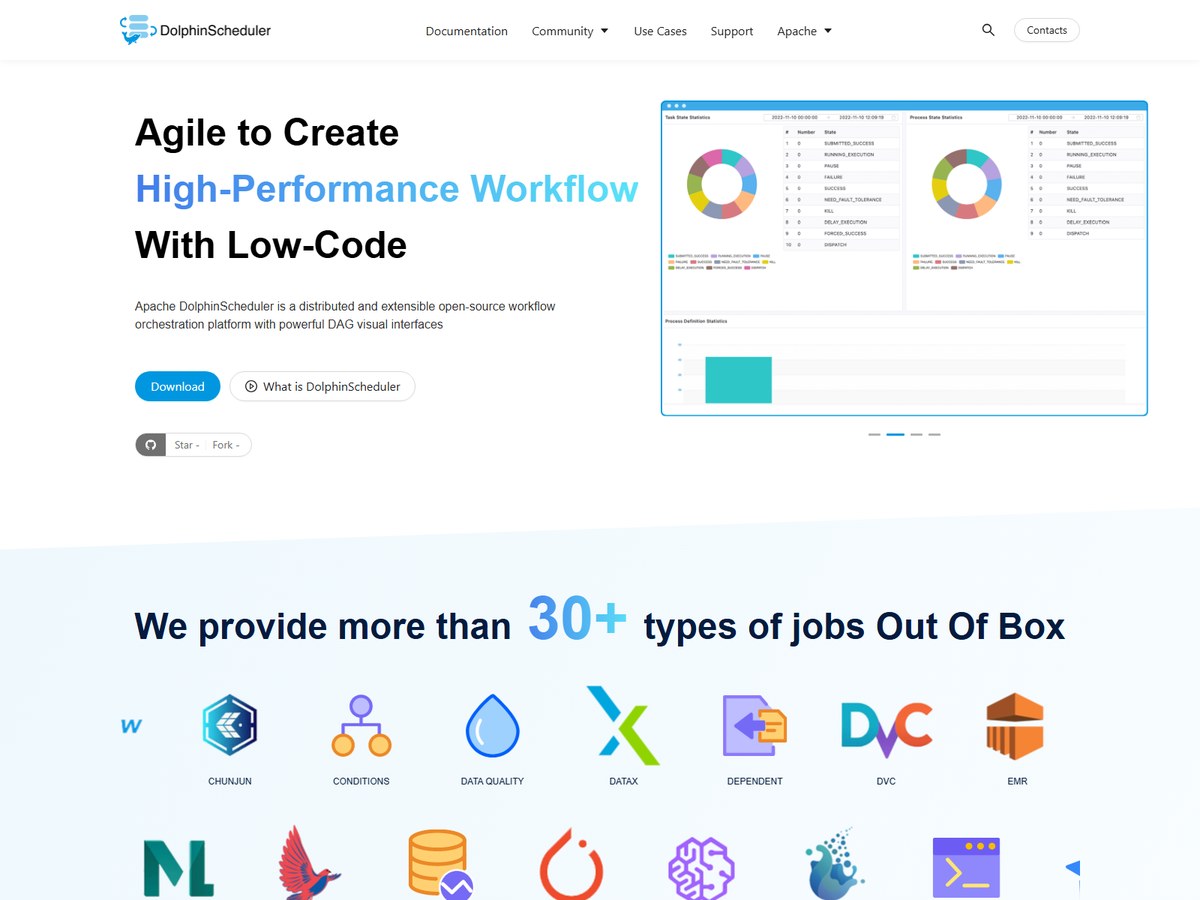
Apache DolphinScheduler has 14,553 GitHub stars and calls itself a modern data orchestration platform for agile, low-code development of high-performance workflows. You can create and manage workflows by drag and drop in a web UI, or through a Python SDK or Open API. It is built to handle complex task dependencies in data pipelines, and its homepage says it offers more than 30 types of jobs out of the box. The README claims it is several times faster than other orchestration platforms and can handle tens of millions of tasks per day, using a decentralized multi-master, multi-worker architecture with horizontal scaling. Other features include four deployment modes (Standalone, Cluster, Docker and Kubernetes), workflow versioning, pausing and recovering runs, multi-tenancy and backfill from the web UI. It is an Apache project under Apache 2.0.

Best forBig data teams that want drag-and-drop workflows and huge task volumes
Skip it ifYou prefer defining every pipeline in code

Source: github.com/apache/dolphinscheduler

9
Mage by Mage
Image: Mage (official site)

Mage

Mage · Notebook-style tool for building data pipelines

8,848 GitHub stars

A friendly notebook-style pipeline builder.

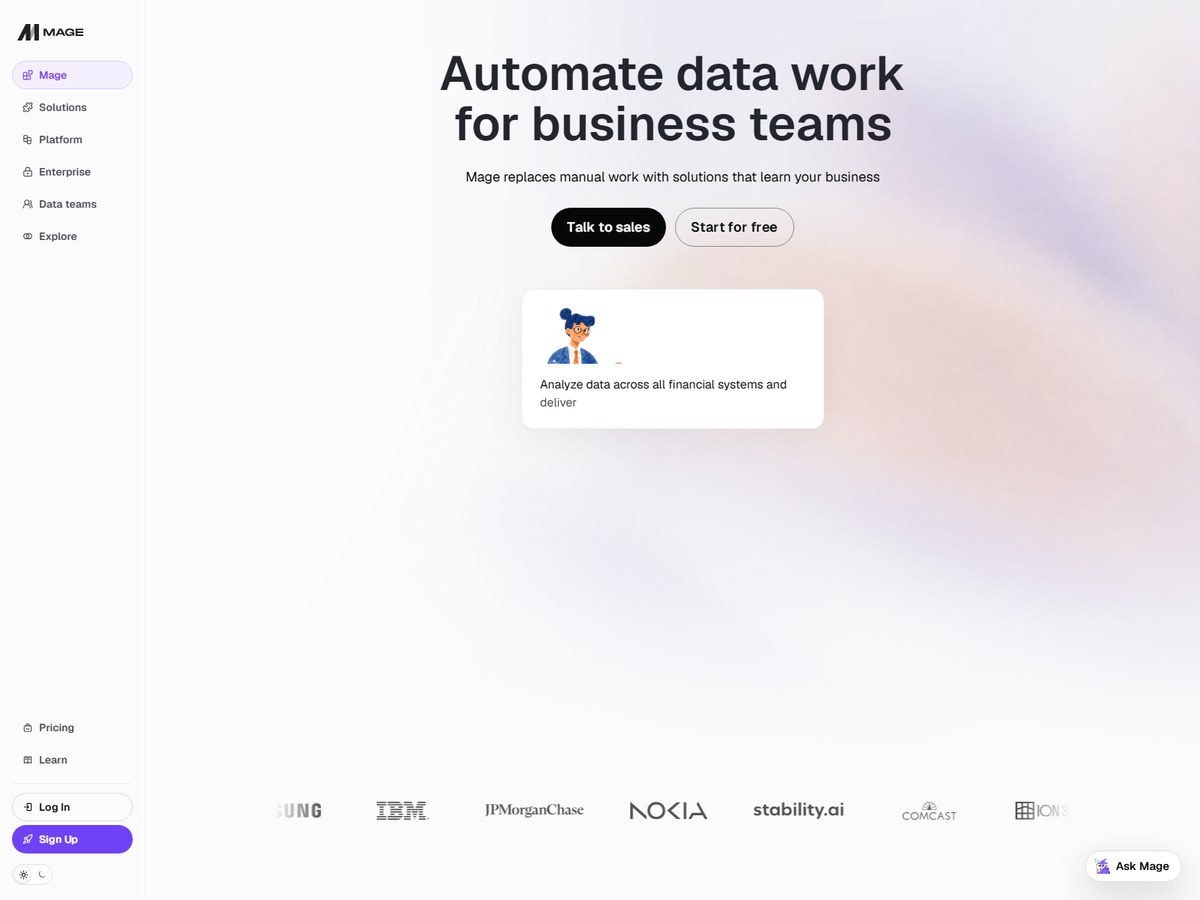
Mage has 8,848 GitHub stars. Its open-source edition, Mage OSS, is a self-hosted development environment for building production-grade data pipelines, ideal for automating ETL tasks, designing data flows and orchestrating transformations in a fast, notebook-style interface. You build pipelines block by block using Python, SQL or R, then run them manually or on a schedule with cron support. Prebuilt connectors link to databases, APIs and cloud storage, visual debugging shows step-by-step logs and live data previews, and you can build and run dbt models directly inside it. Setup takes Docker, pip or conda, with no cloud account required. When you need to scale, Mage Pro, the company's core platform, adds enterprise orchestration, collaboration and AI-powered workflows. Mage OSS is open source under Apache 2.0.

Best forData engineers who like building pipelines in a notebook-style editor
Skip it ifYou need enterprise orchestration without paying for Mage Pro

Source: github.com/mage-ai/mage-ai

10
Flyte by Flyte (LF AI & Data Foundation)
Image: Flyte (official site)

Flyte

Flyte (LF AI & Data Foundation) · Orchestrator for ML pipelines, models and agents in Python

7,840 GitHub stars

The ML-first orchestrator.

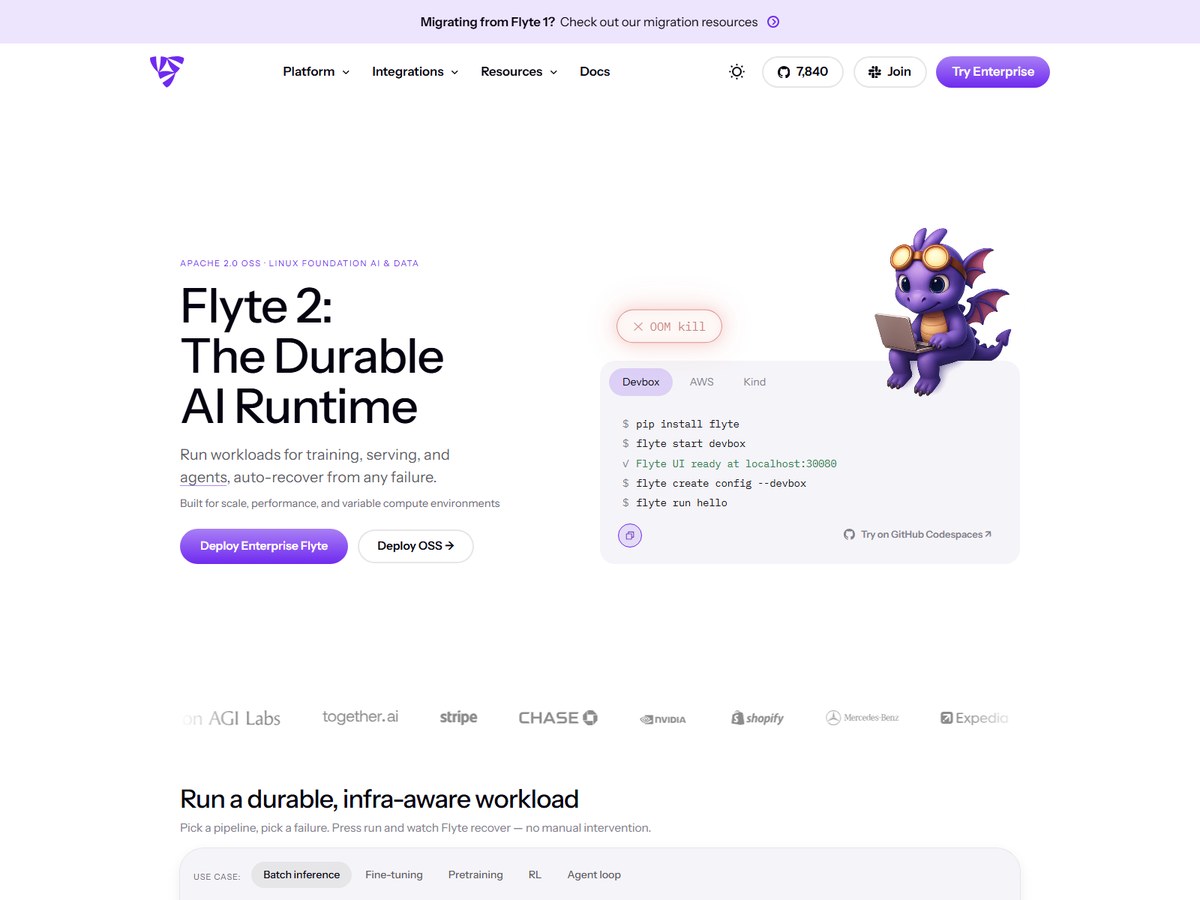
Flyte has 7,840 GitHub stars and is built for machine learning: its README promises to "reliably orchestrate ML pipelines, models, and agents at scale, in pure Python." Flyte 2 is now generally available, with Flyte 1 still maintained on a separate branch. Its GitHub description stresses type-safe, distributed orchestration of agents, ML pipelines and real-time inference on Kubernetes, in pure Python with async/await. You can also serve models with it, and a terminal UI and a local Devbox give you a rich local development experience, which you can try in GitHub Codespaces. The open-source Flyte 2 backend deploys on your own Kubernetes cluster with Helm, and an enterprise-ready backend is available from Union.ai. Flyte is a graduated project of the LF AI & Data Foundation and is open source under Apache 2.0.

Best forMachine learning teams orchestrating training and inference on Kubernetes
Skip it ifYou only run classic ETL jobs

Source: github.com/flyteorg/flyte

Questions people ask

What is the best data orchestration tool?

Apache Airflow is the most-starred, with 47,488 GitHub stars, and is the industry standard. Kestra (30,235 stars) is the pick for YAML and no-code workflows, and Prefect (24,159 stars) is the easiest way to orchestrate Python scripts.

What does a data orchestration tool do?

It schedules and runs the steps of a data pipeline in the right order, handles dependencies, retries failed tasks and lets you monitor every run, so data lands where it should on time.

Which orchestration tools run on Kubernetes?

Argo Workflows is a Kubernetes-native engine where each step is a container. Flyte 2 deploys on Kubernetes with Helm, and Apache DolphinScheduler offers a Kubernetes deployment mode.

Is Dagster part of Prefect?

Yes. Dagster's website says Dagster is now part of Prefect, and Prefect describes Prefect and Dagster as open-source Python frameworks for workflow and data orchestration.

How were these tools ranked?

By GitHub stars on each project's official repository, read November 15, 2026.

How we ranked

GitHub stars on each project's official repository, read November 15, 2026. Stars measure developer interest, not paying customers or production use, so treat them as a guide to popularity. Every number on this page comes from the source linked under each pick, and every photo shows the actual product. Brands can't pay to be on this list.

List source: github.com/apache/airflow · Updated 2026-11-15