Zendesk is the biggest knowledge base software vendor by published customers, with 80,000+ companies, and its Suite plans add an AI-powered help center to its help desk. Help Scout (12,000+ brands) is the friendliest help desk with built-in knowledge bases, and Nuclino (12,000+ teams) is the fastest simple internal wiki. Helpjuice (7,000+ companies) is a dedicated knowledge base with flat pricing, and Slite (1,700+ companies) uses AI to keep docs current.
How it's ranked: Customers, companies, brands or teams each vendor says it serves, as published on its own website (read November 13, 2026). Counts are each company's own claims and are measured differently. Confluence, Document360, Guru, KnowledgeOwl and Notion publish no exact customer count, so they are ranked last, in alphabetical order; Notion publishes a user count (100M users) but not a company count.
Zendesk · Help desk with an AI knowledge base and help center
80,000+ companies
The safe pick for support-led knowledge bases.
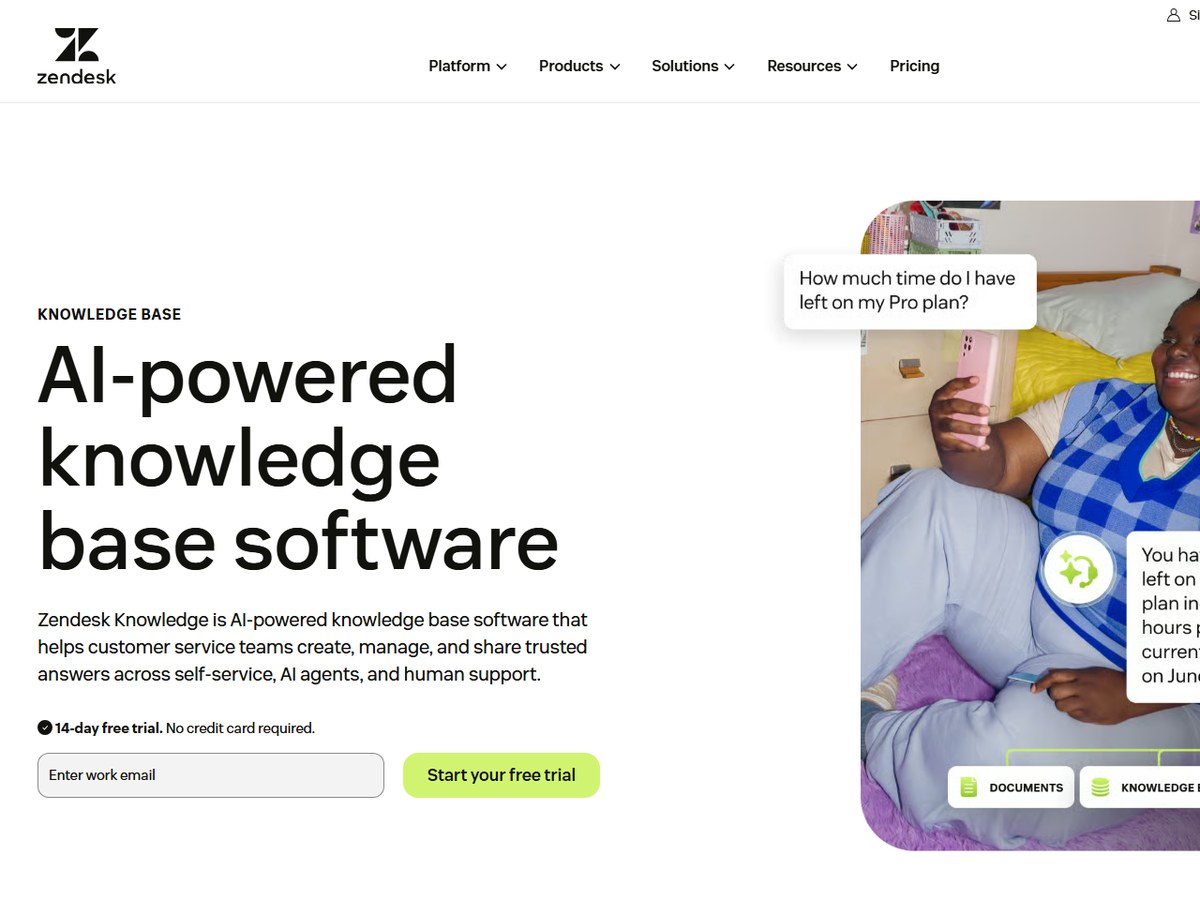
Zendesk is the biggest name here: its knowledge base page says 80,000+ companies choose Zendesk for AI service. Zendesk Knowledge is pitched as AI-powered knowledge base software that helps customer service teams create, manage and share trusted answers across self-service, AI agents and human support. A knowledge builder can create a knowledge base in minutes by analyzing historical tickets to find common questions, and connectors bring in existing knowledge without migrating or copying it. An admin copilot points out content gaps and outdated articles. The help center comes with the Suite plans rather than the basic Support Team plan: Suite Team costs $55 per agent per month paid yearly and includes one help center in one language, while Suite Professional, at $115, allows up to 5 help centers in 40+ languages. There is a 14-day free trial with no credit card required.
Best forCustomer service teams that want the knowledge base inside their help desk
Help Scout · Help desk with built-in knowledge bases
12,000+ brands
Help desk and knowledge base in one friendly package.
Help Scout is a help desk with a knowledge base built in, and it says it powers support for 12,000+ customer-first brands. The knowledge base sits next to a shared inbox, live chat and an AI agent called Scout, which Help Scout says resolves 73% of incoming requests on average. Copilot lets agents ask questions instead of searching the knowledge base themselves. Even the entry Standard plan, $25 per user per month billed annually, includes multiple knowledge bases, along with live chat and SMS and an AI inbox assistant. Plus costs $45 and Pro $75 per user per month, and the Envoy AI add-on is charged at $0.75 per resolution. Help Scout says 80% of companies stay for 4+ years and that 99% of customers hear back in under 24 hours. It fits growing support teams that want self-service articles without buying a separate tool.
Best forSmall and midsize support teams that want help desk and knowledge base together
Nuclino is a lightweight internal wiki that says it is trusted by 12,000+ teams. It calls itself your team's collective brain: a modern, simple and blazingly fast way to collaborate, bringing knowledge, docs and projects together in one place. The idea is to replace several collaboration tools with just one, so information doesn't end up in silos and people switch context less. Nuclino says it was built for speed from the ground up, and a lead software engineer at Vistaprint credits it with fewer meetings, less code re-work and faster development. There is a free plan with up to 50 items, up to 3 canvases and 2GB of total storage, and paid Starter and Business plans are priced per user per month, with savings of up to 25% for yearly billing. It suits small and midsize teams that want a quick wiki rather than a full help desk.
Best forSmall teams that want a fast, uncluttered internal wiki
Skip it ifYou need a public, customer-facing help center
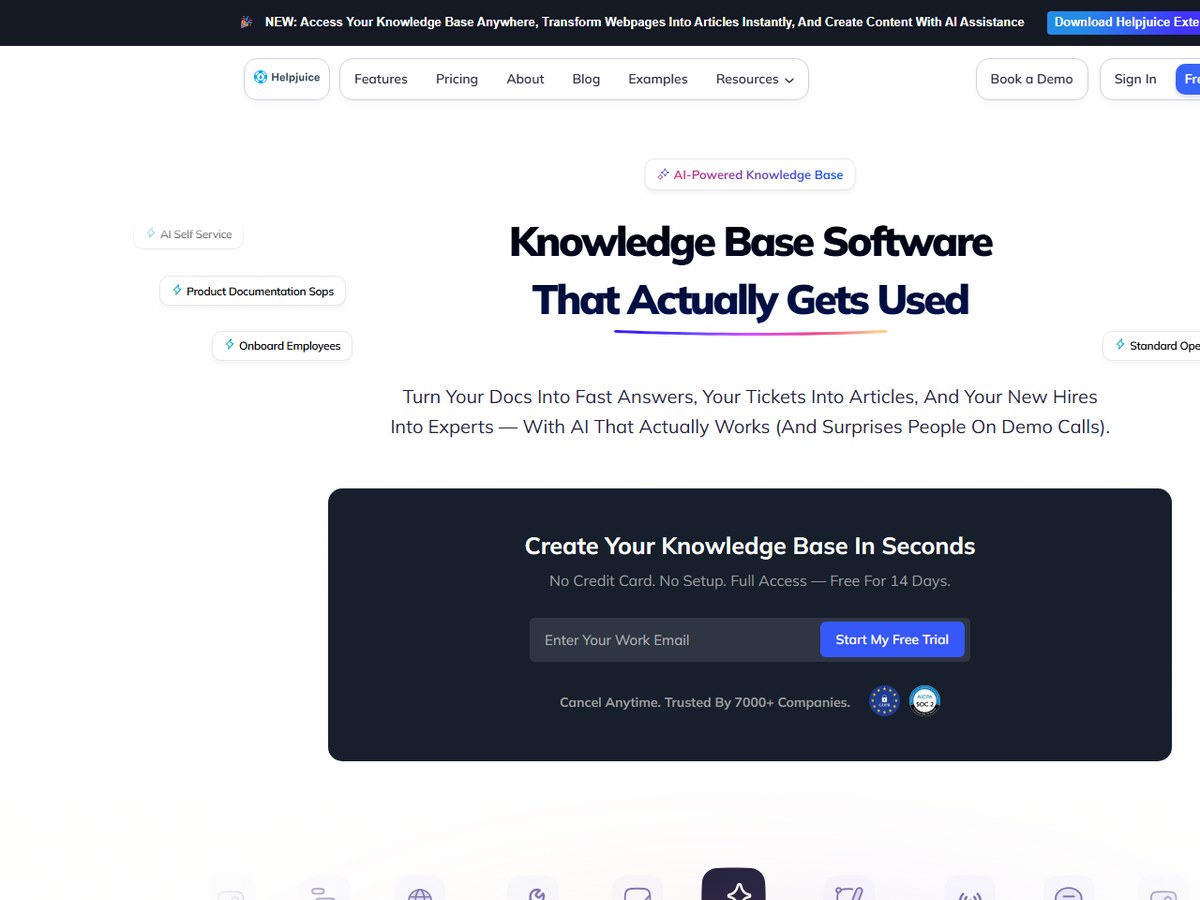
Helpjuice is a dedicated knowledge base tool, and it says it is trusted by 7000+ companies and over 7,000,000 users, with 8500+ knowledge bases built on it. It serves both public help centers and internal wikis, with search that it says works even when spelling doesn't, support for 50+ languages and AI that turns your docs into fast answers. Helpjuice claims customers can deflect 30-50% of support tickets; Virgin Mobile, for one, reports 40% more customers serving themselves. Pricing is flat rather than per seat: the Knowledge Base plan is $249 a month for 30 users, AI-Knowledge Base is $449 for 100 users with SSO and the AI suite, and Unlimited AI-Knowledge Base is $799 for unlimited users. There is a 14-day free trial with no credit card, and 24h migration help is included.
Best forCompanies that want one knowledge base for customers and staff at a flat price
The knowledge base that rewrites its own stale docs.
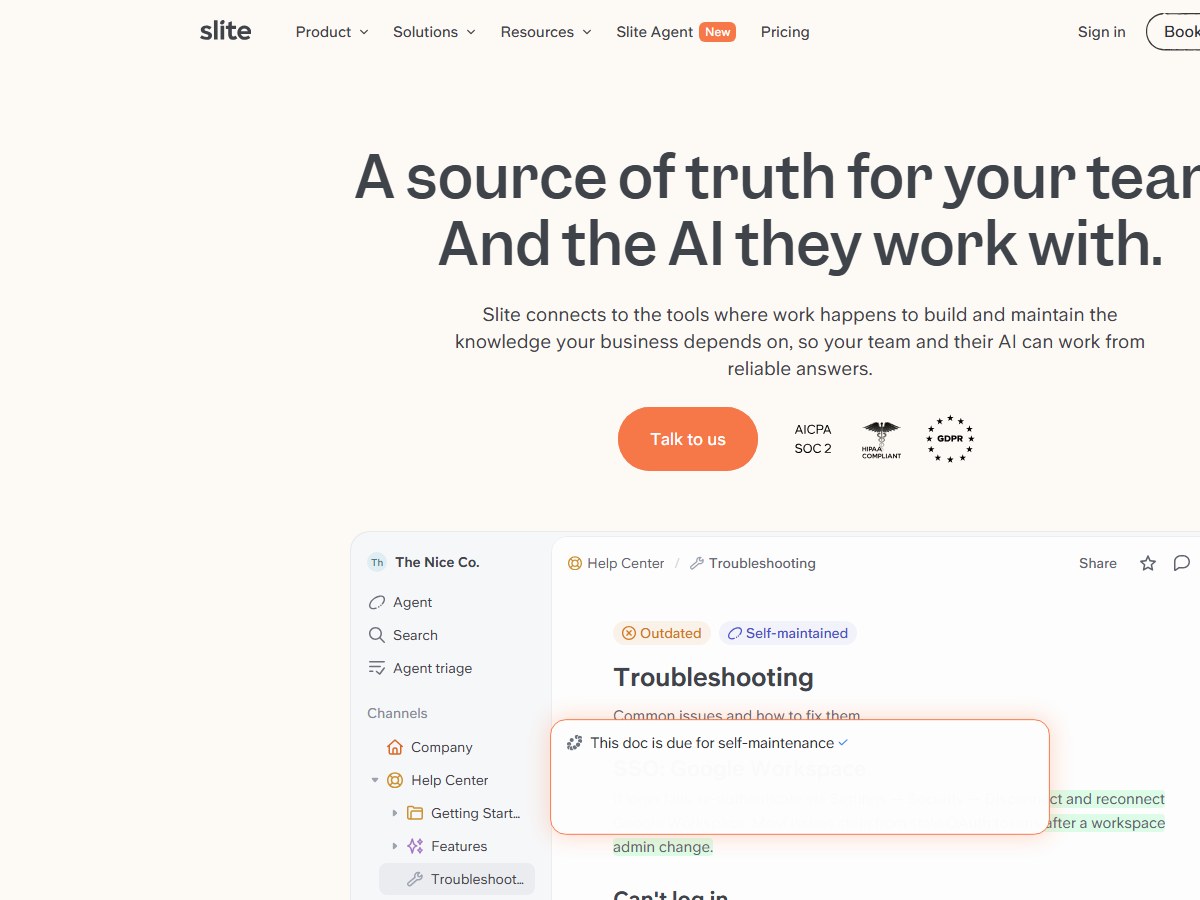
Slite is an AI-first internal knowledge base that says it is trusted by 1,700+ companies as their single source of truth. Its headline feature is Slite Agent, which watches Slack, Linear, GitHub and your codebase, spots outdated facts in your documentation and drafts updates you approve in one click. Answers respect access rules, since every query inherits the user's permissions, and Slite says your data is never used to train AI models. It is SOC 2 Type II, HIPAA and GDPR compliant and EU-hosted, which suits European teams. Pricing is simple: Basic is $10 and Pro $20 per user per month billed yearly, Enterprise is custom, and a 14-day free trial needs no credit card. Agorapulse says the number of questions its team fields has dropped 10x since adopting it.
Best forTeams whose docs go stale and who want AI to keep them current
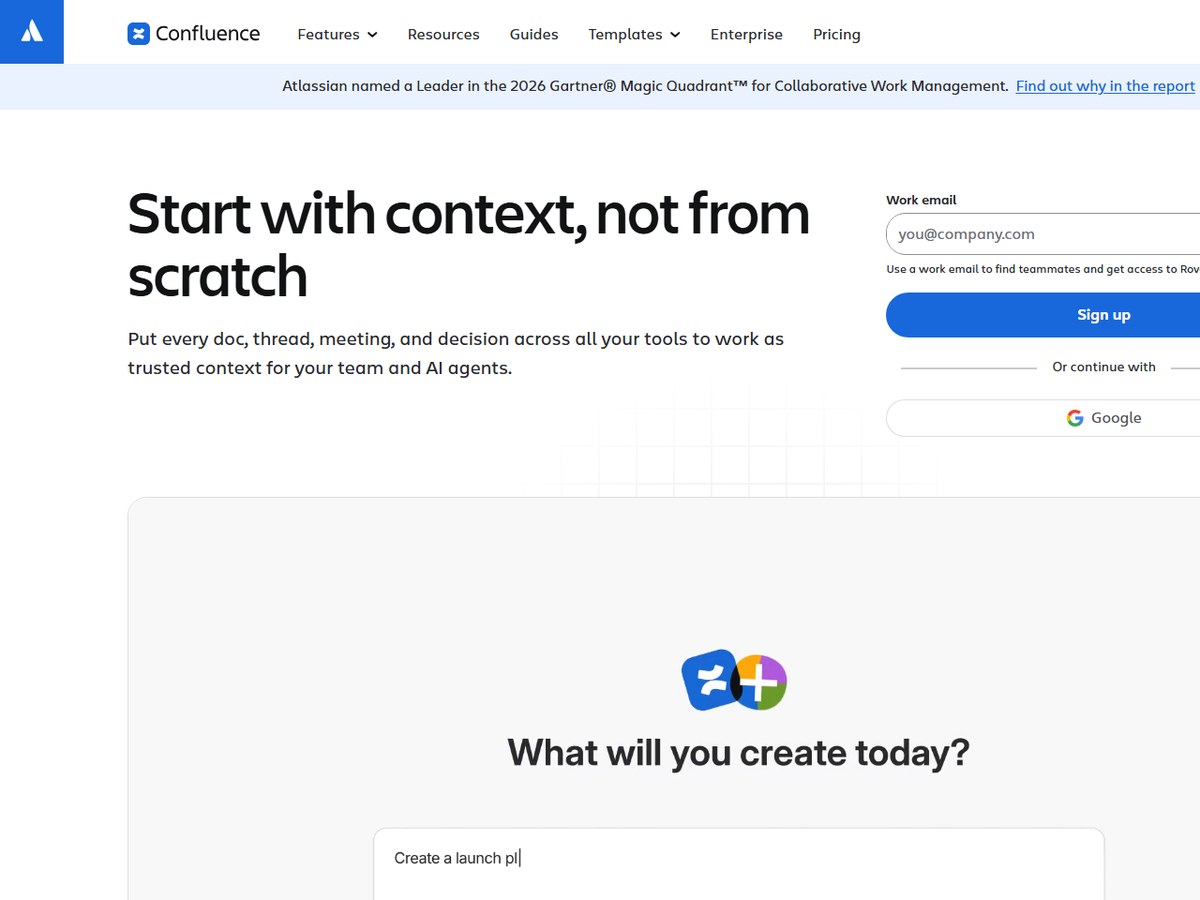
Confluence is Atlassian's team wiki, and its product page shows logos including Reddit, Dropbox, Roblox and Domino's. That page does not publish a customer count, so Confluence ranks below the vendors that do. Atlassian pitches it as a way to put every doc, thread, meeting and decision across all your tools to work as trusted context for your team and AI agents. Rovo, its AI search, aims to give relevant, accurate answers without hunting through pages and tools, and the Rovo MCP Server lets you plug Confluence into Claude, ChatGPT or your IDE. Status markers and automation flag outdated pages, a common pain point in big wikis. Atlassian says it was named a Leader in the 2026 Gartner Magic Quadrant for Collaborative Work Management. It fits software and project teams that already live in the Atlassian world.
Best forSoftware and project teams already using Jira and other Atlassian tools
Skip it ifYou want a simple customer-facing help center
Document360 · Knowledge base platform for help centers and internal docs
No exact count published ("thousands of businesses")
A deep, purpose-built knowledge base platform.
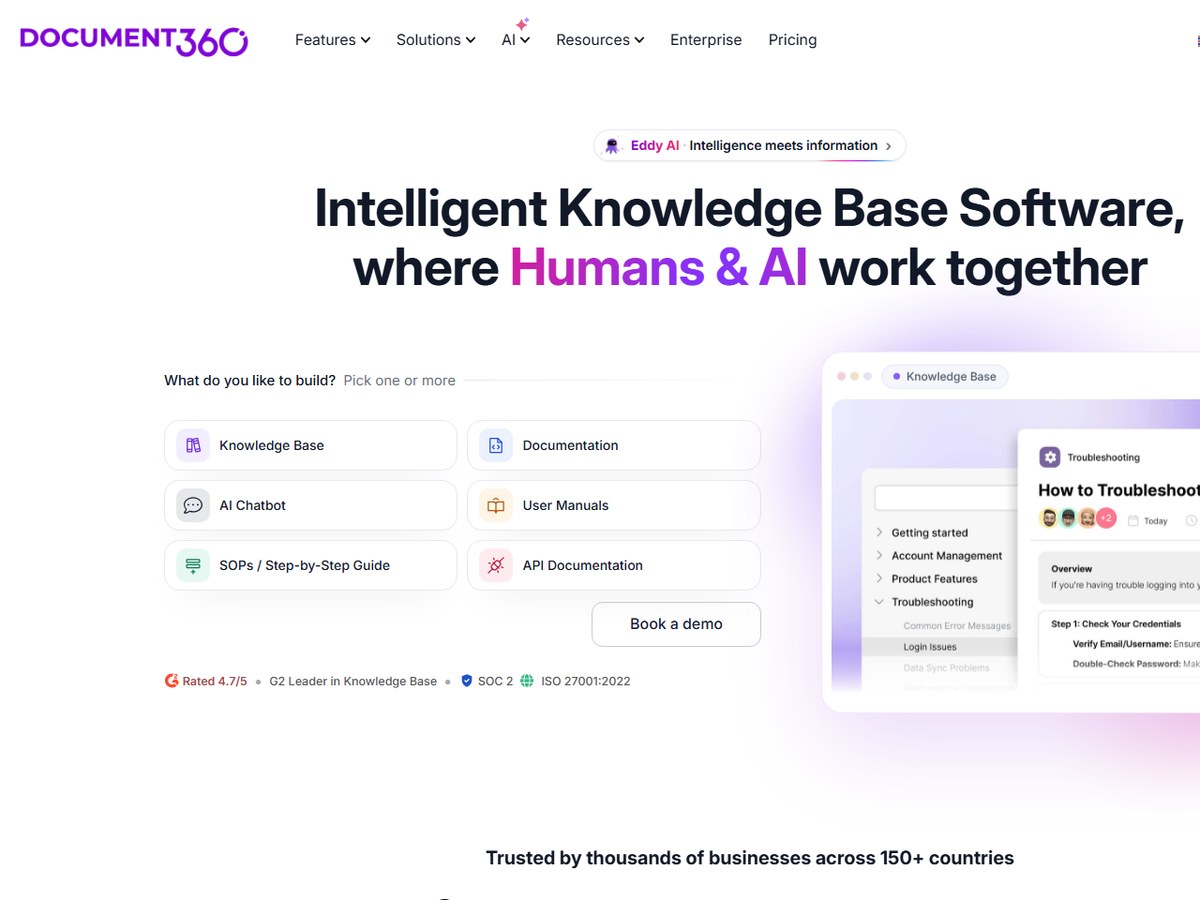
Document360 is a dedicated knowledge base platform that says it is trusted by thousands of businesses across 150+ countries, but it gives no exact count, so it ranks with the vendors that publish none. It is rated 4.7/5 on G2 from 1,400+ verified reviews and is a G2 Leader in Knowledge Base. It covers public knowledge bases, internal SOPs, user manuals and API documentation, with 100+ features for authoring, search, security and self-service. Its AI, Eddy AI, adds conversational search that cites every source, a chatbot, and a writing agent that generates documentation from videos and files. An MCP Server connects your knowledge base to ChatGPT, Claude and Copilot, and there are 60+ out-of-the-box connectors. Document360 holds SOC 2 and ISO 27001:2022 certifications. It suits teams that want customer-facing docs and internal knowledge under one roof.
Best forTeams that need customer help centers, SOPs and API docs in one tool
Guru · Verified internal knowledge platform for people and AI
No customer count published
The pick when knowledge has to be verified.
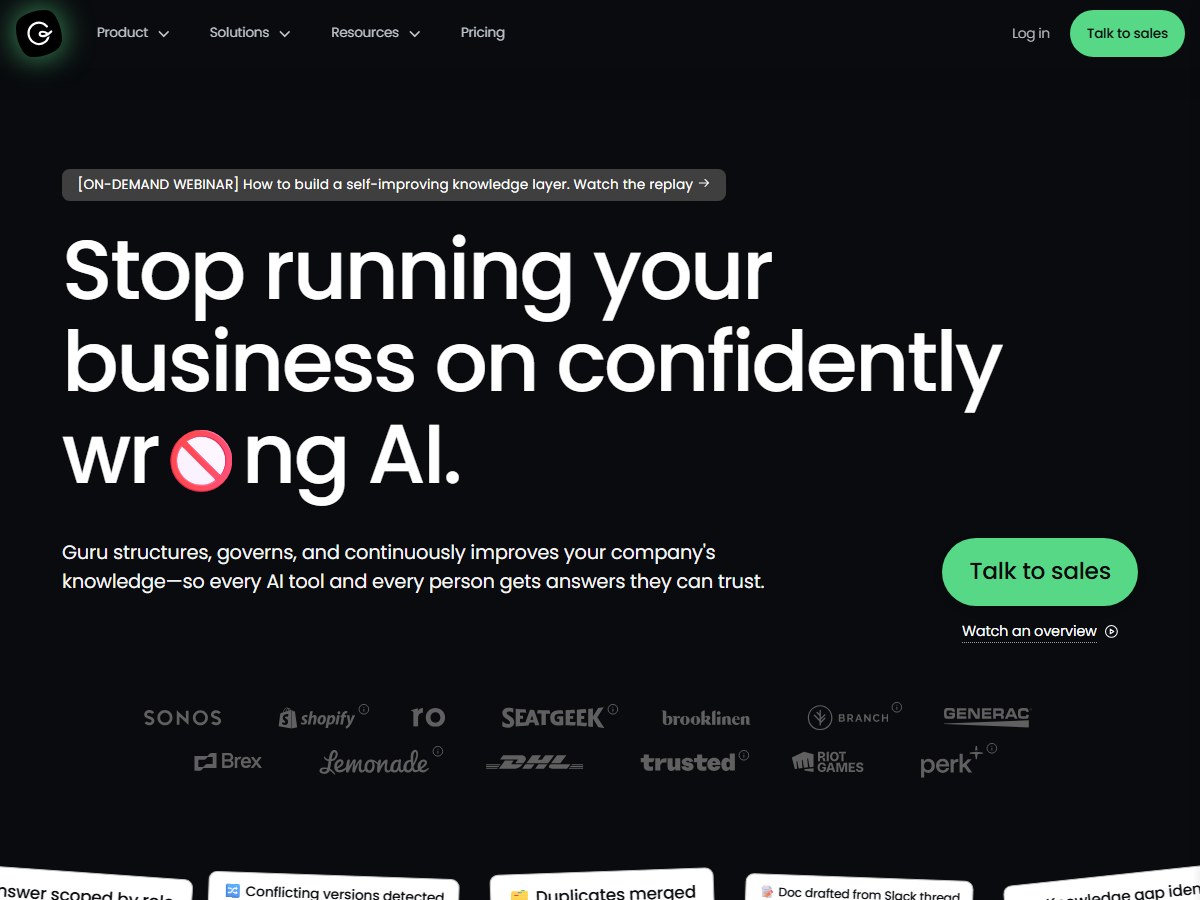
Guru is an internal knowledge platform built around trust: it structures, governs and continuously improves your company's knowledge so every AI tool and every person gets answers they can trust. Its homepage publishes no customer count. Guru's pitch is verification. It says half of all AI responses contain inaccuracies without verified knowledge, and that its quality automations take you from 60% to 100% of knowledge assessed and verified. Answers carry citations, the AI is permission-aware, and there are full audit trails. Guru is SOC 2 Type 2 certified and HIPAA-ready, with enterprise SSO and built-in DLP. It is rated 4.7/5 on G2, TrustRadius and Capterra, and a case study says Lemonade reached 90% adoption. Prices are not on the homepage, whose main button is Talk to sales. It fits companies where wrong answers are costly.
Best forLarger companies that feed company knowledge into AI tools
KnowledgeOwl · Knowledge base for internal and customer documentation
No customer count published
Great value when readers far outnumber writers.
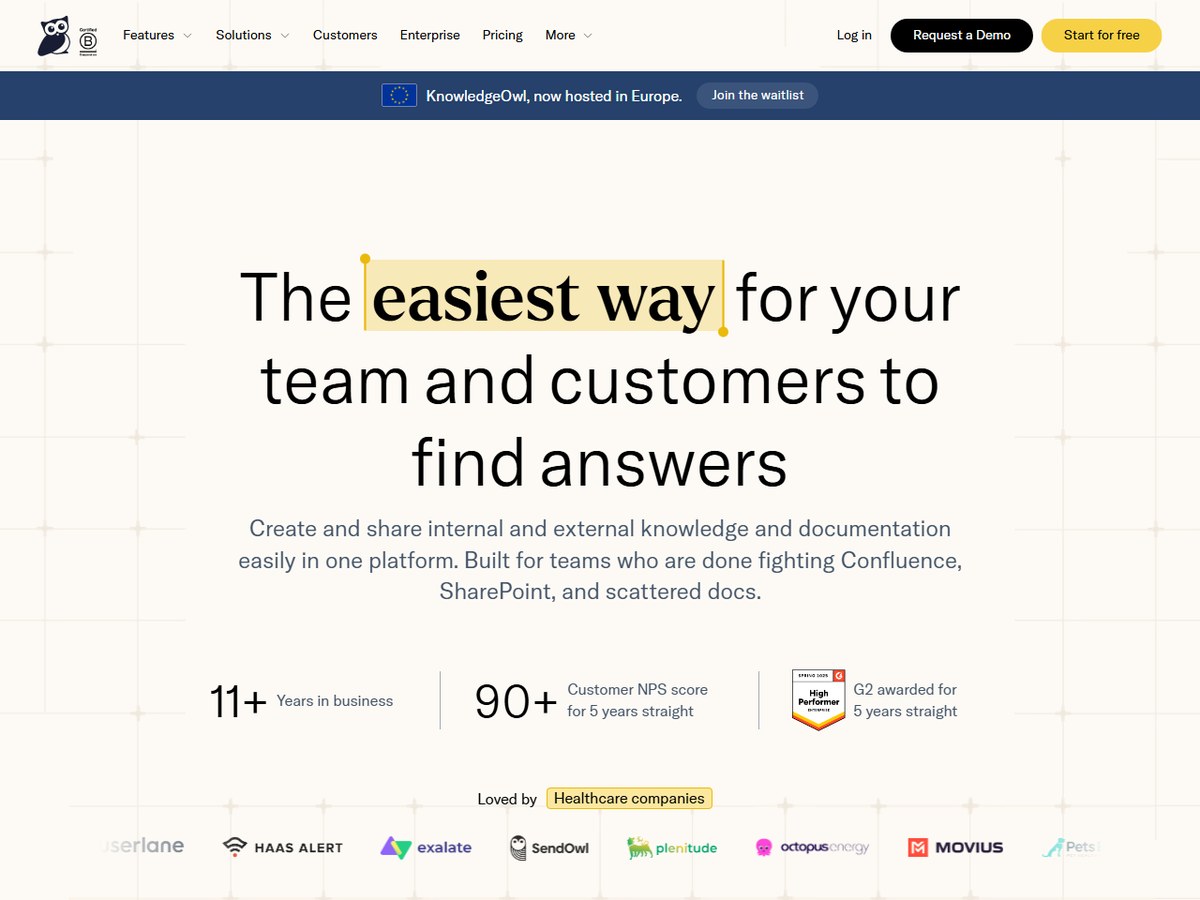
KnowledgeOwl is a focused knowledge base tool for internal and customer-facing documentation, with 11+ years in business and a customer NPS of 90+ for 5 years straight. It publishes no customer count. Every plan includes unlimited private and public readers, unlimited file limits, a complimentary theme build and white-glove migration; you pay by author instead. Basic is $100 a month with 1 author and 1 knowledge base, Pro is $250 and Business $500, with extra authors at $25 and extra knowledge bases at $50 a month. Yearly billing saves 10%, and nonprofits and B Corps get 25% off. Its AI chatbot answers only from your knowledge base, shows its sources and says when it doesn't know, and KnowledgeOwl says your data never trains LLMs. It averages 4.6 on G2.
Notion Labs · All-in-one workspace used as a company wiki
No company count published (says 100M users)
The most popular workspace, wiki included.
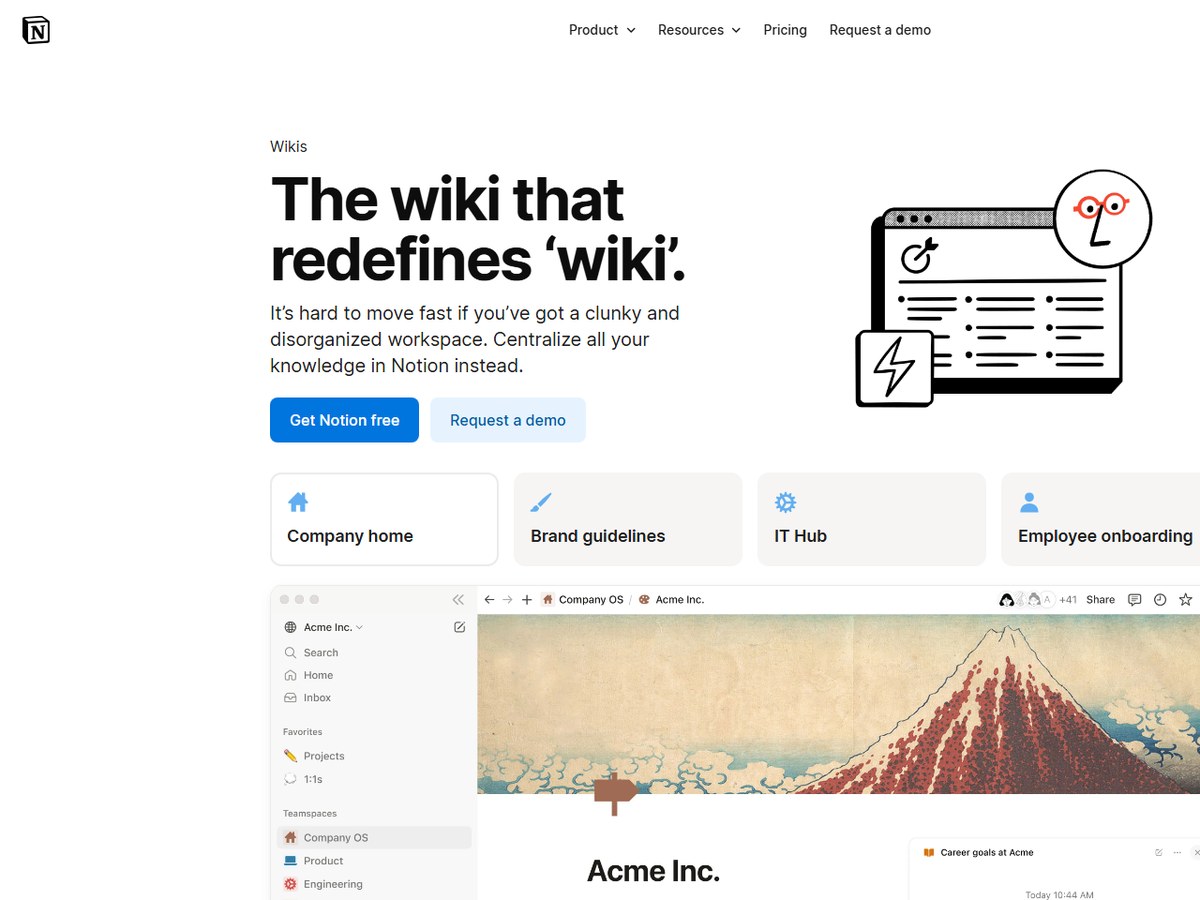
Notion is the all-in-one workspace many teams use as their company wiki, and its own numbers are huge: 100M users in over 50 countries, and it says 62% of the Fortune 100 use Notion. It does not publish a count of customer companies, the measure this list ranks on, so it sits with the vendors that publish none. Notion says it has been G2's #1 knowledge base for 3 consecutive years. Its wiki features include verification so readers know a page is current, Synced Blocks that apply one edit everywhere the content appears, and pages anyone can update without being tech-savvy. Notion AI gives answers with citations, and agents keep work moving. There is a free plan, Plus costs $10 and Business $20 per seat per month, and Enterprise has custom pricing.
Best forTeams that want docs, projects and wiki in one place
Skip it ifYou need a dedicated customer help center
Zendesk is the largest by published customers, with 80,000+ companies, and suits customer service teams. For an internal wiki, Nuclino (12,000+ teams) and Notion are popular choices; for a dedicated knowledge base, look at Helpjuice or Document360.
What is the difference between an internal and an external knowledge base?
An external knowledge base, or help center, is public self-service content for customers. An internal knowledge base is a private wiki for employees. Helpjuice, Document360 and KnowledgeOwl handle both; Nuclino, Slite, Guru and Confluence focus on internal knowledge.
Is there free knowledge base software?
Notion and Nuclino have free plans; Nuclino's allows up to 50 items. Zendesk, Helpjuice and Slite offer 14-day free trials with no credit card required.
Which knowledge base software charges by author instead of per user?
KnowledgeOwl includes unlimited readers on every plan and charges by author, starting at $100 a month with 1 author. Helpjuice uses flat plans, starting at $249 a month for 30 users.
How were these tools ranked?
By the number of customers, companies, brands or teams each vendor publishes on its own website, read November 13, 2026. Vendors that publish no exact count are ranked last, in alphabetical order.
How we ranked
Customers, companies, brands or teams each vendor says it serves, as published on its own website (read November 13, 2026). Counts are each company's own claims and are measured differently. Confluence, Document360, Guru, KnowledgeOwl and Notion publish no exact customer count, so they are ranked last, in alphabetical order; Notion publishes a user count (100M users) but not a company count. Every number on this page comes from the source linked under each pick, and every photo shows the actual product. Brands can't pay to be on this list.

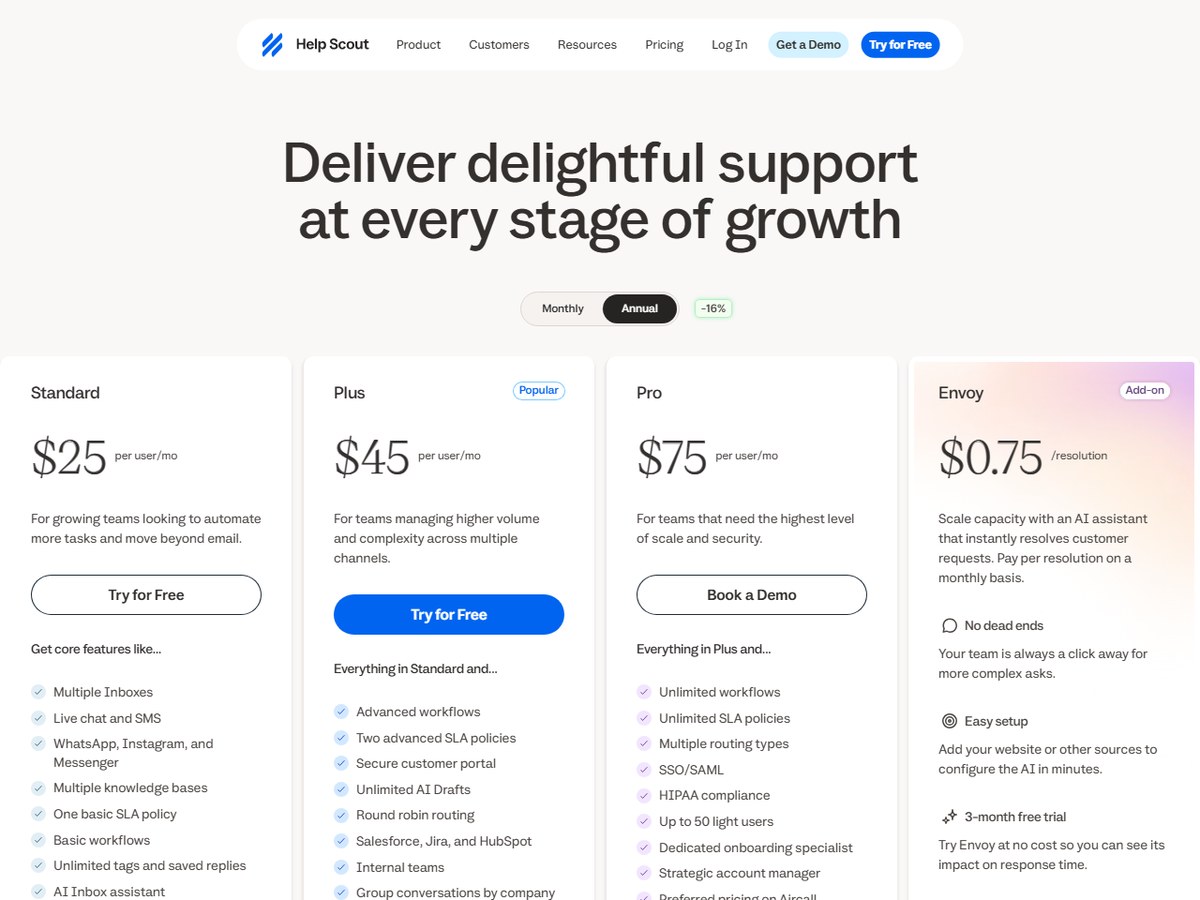 Help Scout12,000+ brands
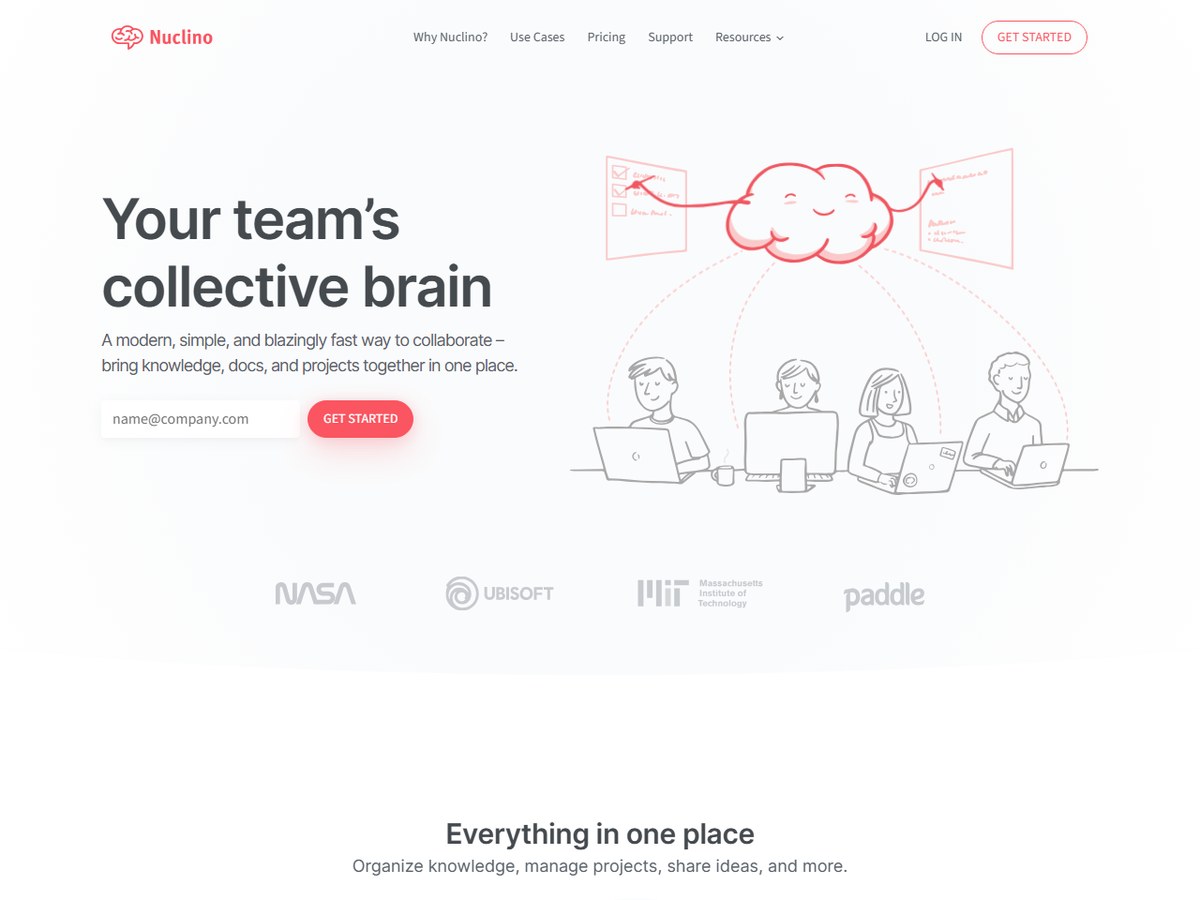 Nuclino12,000+ teams