consumertop10

Home › Software

Top 10 · Software

Top 10 Load Testing Tools

The open-source tools engineers use to see how websites, APIs and apps hold up under heavy traffic, ranked by GitHub stars.

Quick answer

wrk is the most-starred load testing tool, with 40,423 GitHub stars, for raw HTTP benchmarking from one machine. Grafana k6 is second with 32,308 stars and is the best all-round tool for developers writing load tests in JavaScript, and Locust is third with 28,288 stars for tests written in Python. Vegeta, hey and oha follow.

How it's ranked: GitHub stars on each project's official repository, read November 15, 2026. Stars measure developer interest, not paying customers or production use, so treat them as a guide to popularity. Gatling separately reports 300,000+ companies using it.

1
wrk by wrk open-source project
Image: wrk (official GitHub repository)

wrk

wrk open-source project · Command-line HTTP benchmarking tool

40,423 GitHub stars

The raw-speed HTTP benchmark favorite.

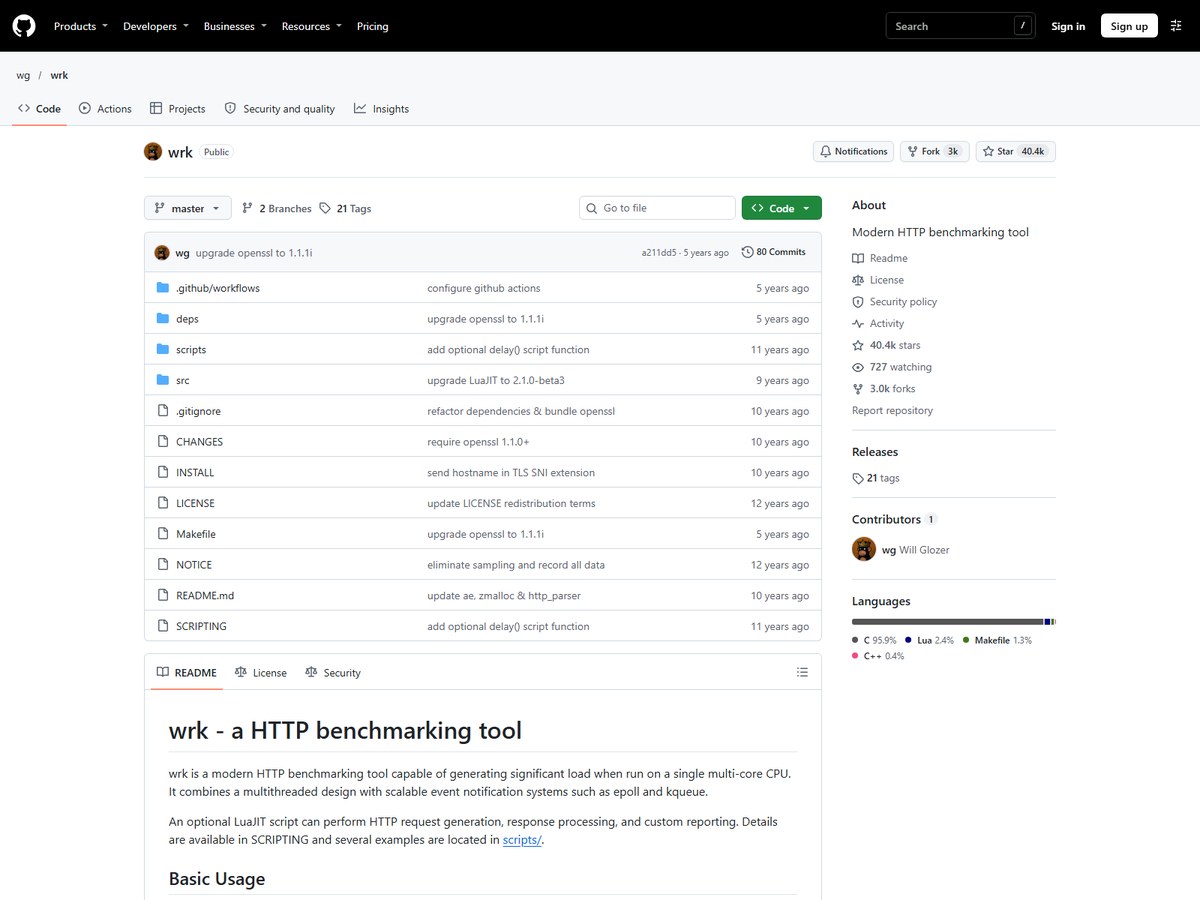
wrk is the most-starred load testing tool on GitHub, with 40,423 stars. Its README calls it a modern HTTP benchmarking tool capable of generating significant load when run on a single multi-core CPU. It combines a multithreaded design with scalable event notification systems such as epoll and kqueue, which is why one laptop can push serious traffic. The README's example runs a 30-second benchmark with 12 threads and 400 open HTTP connections and reports 748,868 requests per second against a local server. You control it with a few flags for connections, duration and threads, and print detailed latency statistics with --latency. An optional LuaJIT script can generate requests, process responses and build custom reports. wrk is a raw benchmarking tool rather than a full testing suite, so it suits quick, hard-hitting tests of a single endpoint.

Best forEngineers who need to hammer one HTTP endpoint as hard as possible from one machine
Skip it ifYou need realistic multi-step user journeys or a GUI

Source: github.com/wg/wrk

2
Grafana k6 by Grafana Labs
Image: Grafana k6 (official site)

Grafana k6

Grafana Labs · Developer-centric load testing tool scripted in JavaScript

32,308 GitHub stars

The best all-round load tester for developers.

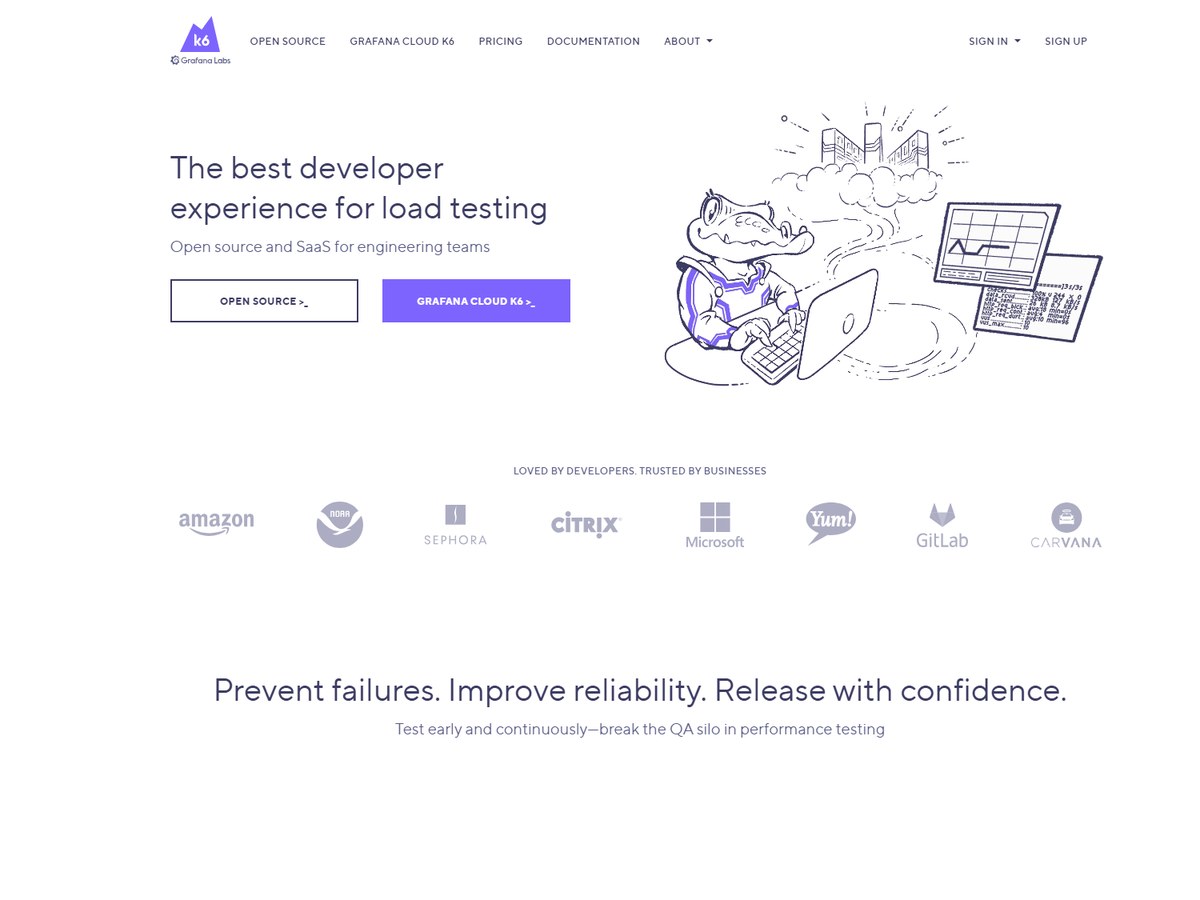
Grafana k6 has 32,308 GitHub stars and is the most popular full-featured load testing tool built for developers. Its README describes it as "like unit testing, for performance" and says its key design goal is the best developer experience. You write tests as code in JavaScript, which k6 runs on an embedded engine with the performance of Go, so you can reuse scripts, keep them in version control and run them in your CI. k6 says even lower-end machines can simulate lots of traffic. It supports HTTP, WebSockets, gRPC, browser testing and more, has a large extension ecosystem, and can export summary or granular metrics to the service of your choice. It is made by Grafana Labs and integrates natively with Grafana Cloud k6, the SaaS version. The open-source k6 is distributed under the AGPL-3.0 license.

Best forDeveloper and DevOps teams that want load tests as code in CI
Skip it ifYou need a point-and-click test recorder

Source: github.com/grafana/k6

3
Locust by Locust open-source project
Image: Locust (official site)

Locust

Locust open-source project · Load testing tool with tests written in Python

28,288 GitHub stars

The best load tester for Python teams.

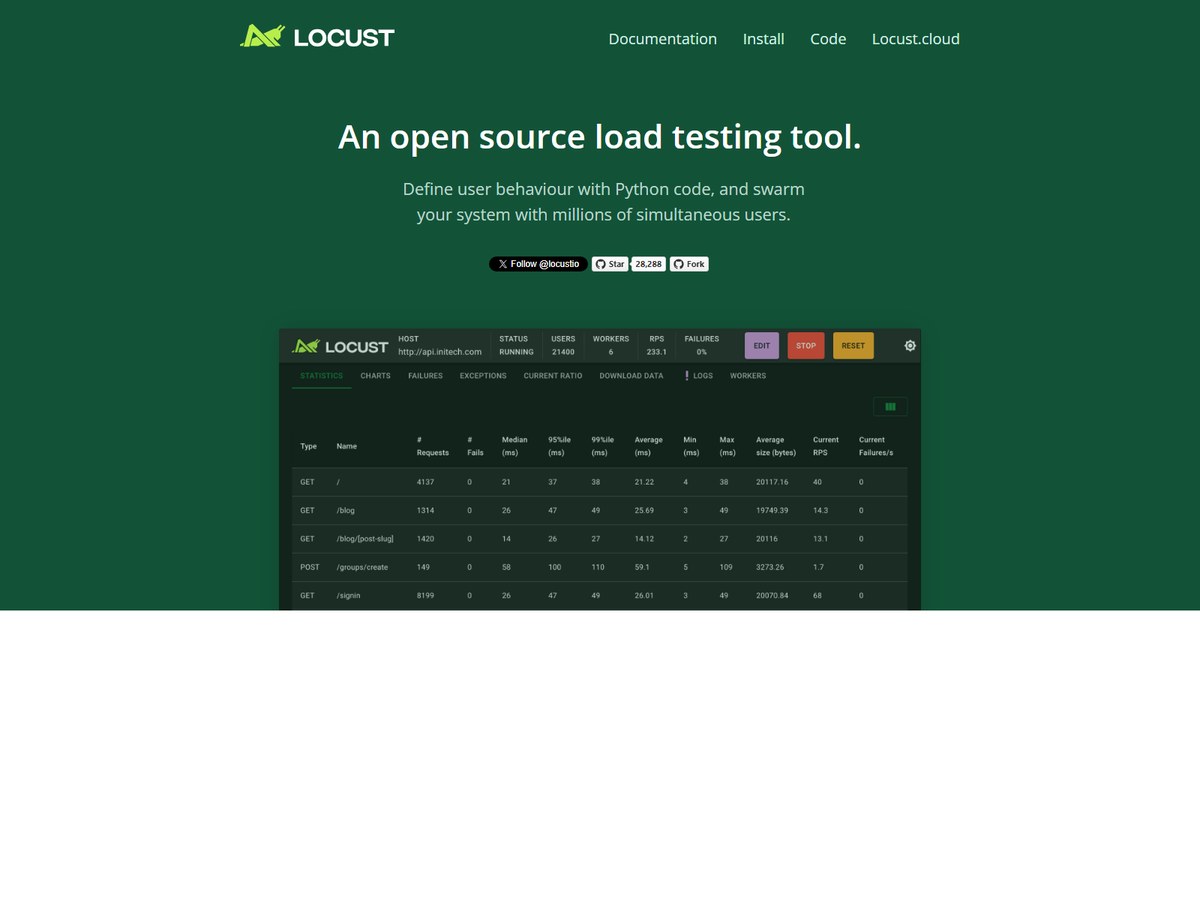
Locust has 28,288 GitHub stars and is an open-source load testing tool for HTTP and other protocols where you define tests in regular Python code. Its homepage pitch: define user behaviour with Python code, and swarm your system with millions of simultaneous users. Because scenarios are just Python, you can loop, add conditions, import any Python library and keep tests in version control, rather than being limited by a GUI or XML format. Locust runs each user in a lightweight greenlet and is event-based, so a single process can handle many thousands of concurrent users, and you can distribute tests across multiple machines. A web-based UI shows throughput, response times and errors in real time and even lets you change the load mid-test, or you can run it headless for CI/CD. Locust is open source under the MIT license.

Best forPython teams simulating many concurrent users
Skip it ifYour team does not write Python

Source: github.com/locustio/locust

4
Vegeta by Vegeta open-source project
Image: Vegeta (official GitHub repository)

Vegeta

Vegeta open-source project · HTTP load testing tool and Go library

25,249 GitHub stars

The constant-rate HTTP drill.

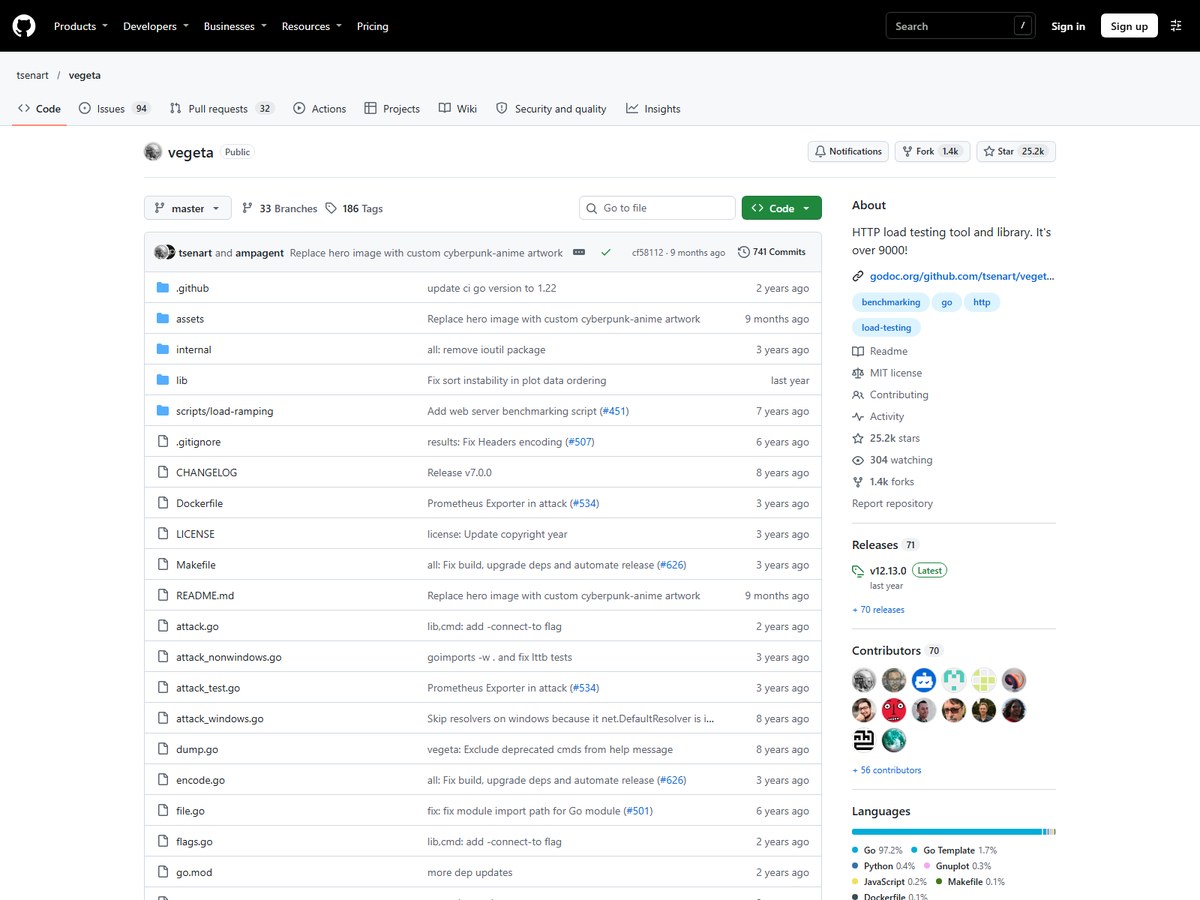
Vegeta has 25,249 GitHub stars and is a versatile HTTP load testing tool built out of a need to drill HTTP services with a constant request rate. Its README adds a joke for fans: "It's over 9000!" Holding the rate steady matters because it avoids what the project calls nasty Coordinated Omission, a measurement error that can make latency look better than it really is. Vegeta works both as a command-line tool and as a Go library, and its CLI is designed with Unix composability in mind, so you can pipe targets in and results out to its extensive reporting commands. It is simple to use for distributed load testing and easy to install as a static binary or through package managers such as Homebrew, MacPorts and FreeBSD packages. Vegeta is open source under the MIT license.

Best forEngineers who need a constant request rate and Unix-style pipelines
Skip it ifYou want a web UI or multi-step scripted scenarios

Source: github.com/tsenart/vegeta

5
hey by hey open-source project
Image: hey (official GitHub repository)

hey

hey open-source project · Tiny HTTP load generator and ApacheBench replacement

20,788 GitHub stars

The simplest way to load test from a terminal.

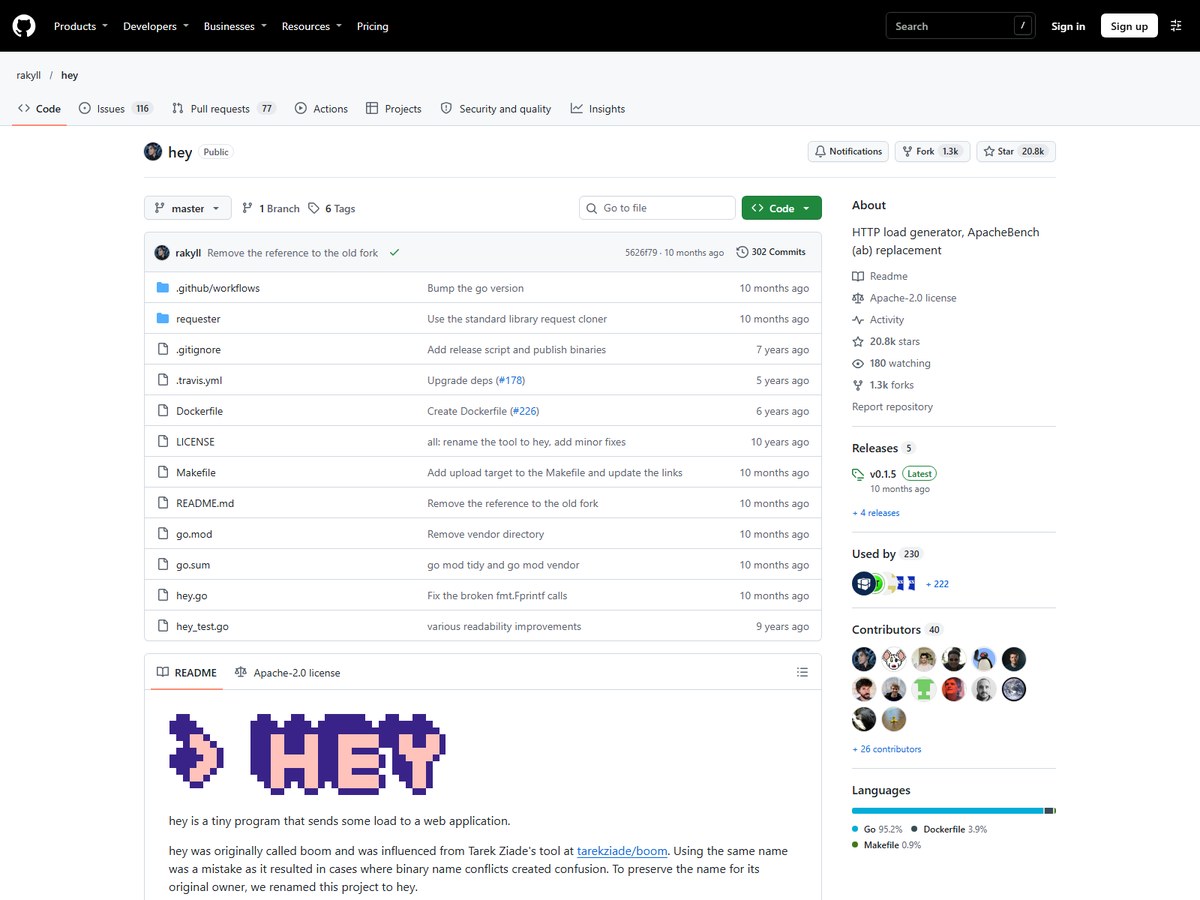
hey has 20,788 GitHub stars and describes itself simply: a tiny program that sends some load to a web application. Its GitHub description calls it an HTTP load generator and a replacement for ApacheBench (ab), the classic Apache benchmarking tool. You tell hey how many requests to send and at what concurrency level, and it prints stats, for example 1,000 requests with 100 concurrent workers. You can also run a test for a set time, send POST requests with a custom body, add custom headers, rate limit each worker, and test HTTP/2 endpoints. Prebuilt binaries are available for Linux, macOS and Windows, and Homebrew users can install it with brew install hey. The project was originally called boom and was renamed to hey to avoid confusion with another tool. It is open source under the Apache-2.0 license.

Best forDevelopers who want a quick, simple load test from the terminal
Skip it ifYou need scripting, reporting dashboards or distributed tests

Source: github.com/rakyll/hey

6
oha by oha open-source project
Image: oha (official GitHub repository)

oha

oha open-source project · HTTP load generator with a live terminal UI

10,682 GitHub stars

hey with a live dashboard, in Rust.

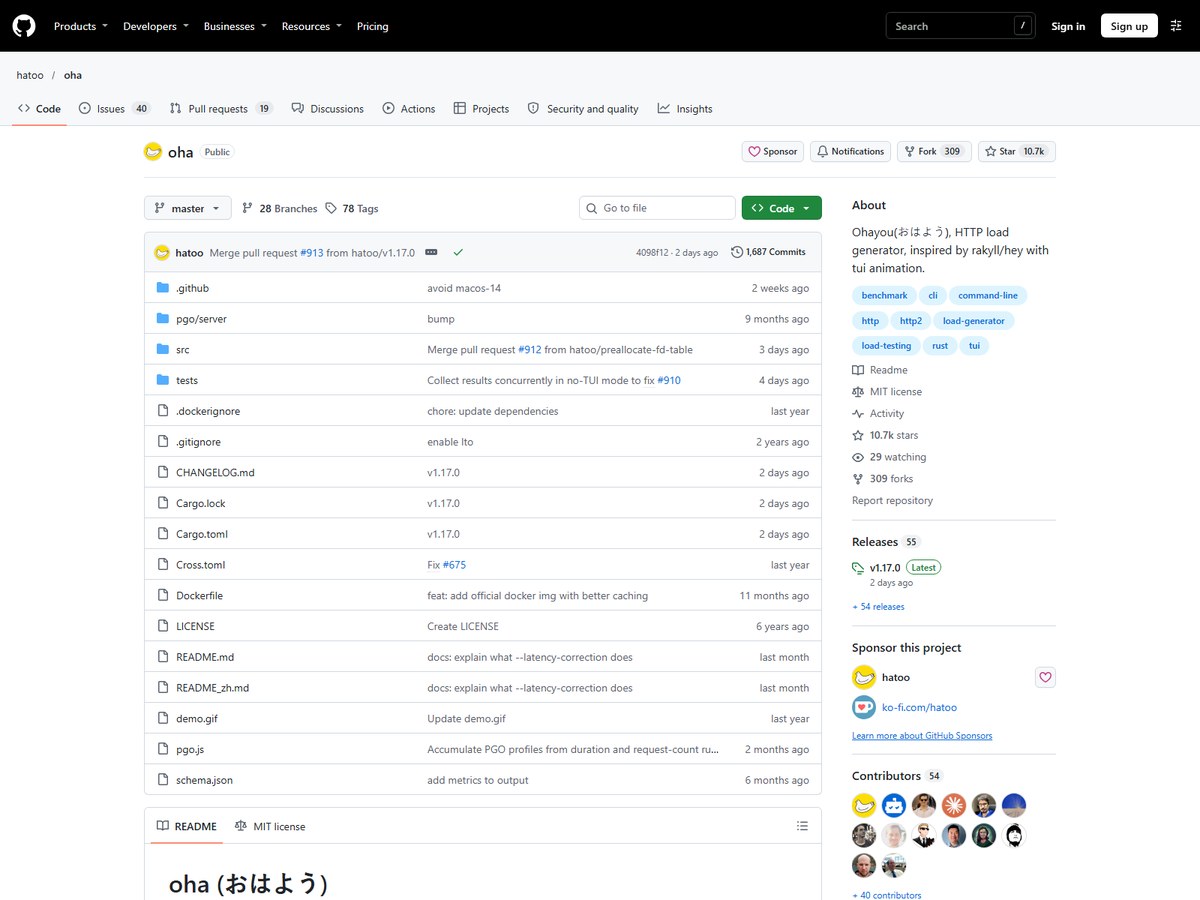
oha, named after the Japanese greeting ohayou, has 10,682 GitHub stars. Like hey, it is a tiny program that sends some load to a web application, but it adds a real-time terminal user interface so you can watch the test as it runs. Its README says it is inspired by rakyll/hey and is written in Rust, powered by tokio and the ratatui terminal UI library. oha installs with cargo install oha, Homebrew (brew install oha), winget on Windows, pacman on Arch Linux and a Debian repository, or as pre-built binaries from its release page. Optional features include native-tls instead of rustls, VSOCK support and experimental HTTP/3 support. For anyone who runs quick HTTP load tests from the command line, it is a modern, fast and more visual alternative to older tools. oha is open source under the MIT license.

Best forDevelopers who like hey but want live charts in the terminal
Skip it ifYou need multi-step user scenarios

Source: github.com/hatoo/oha

7
Apache JMeter by Apache Software Foundation
Image: Apache JMeter (official site)

Apache JMeter

Apache Software Foundation · Java application for load and performance testing

9,604 GitHub stars

The protocol-rich veteran with a GUI.

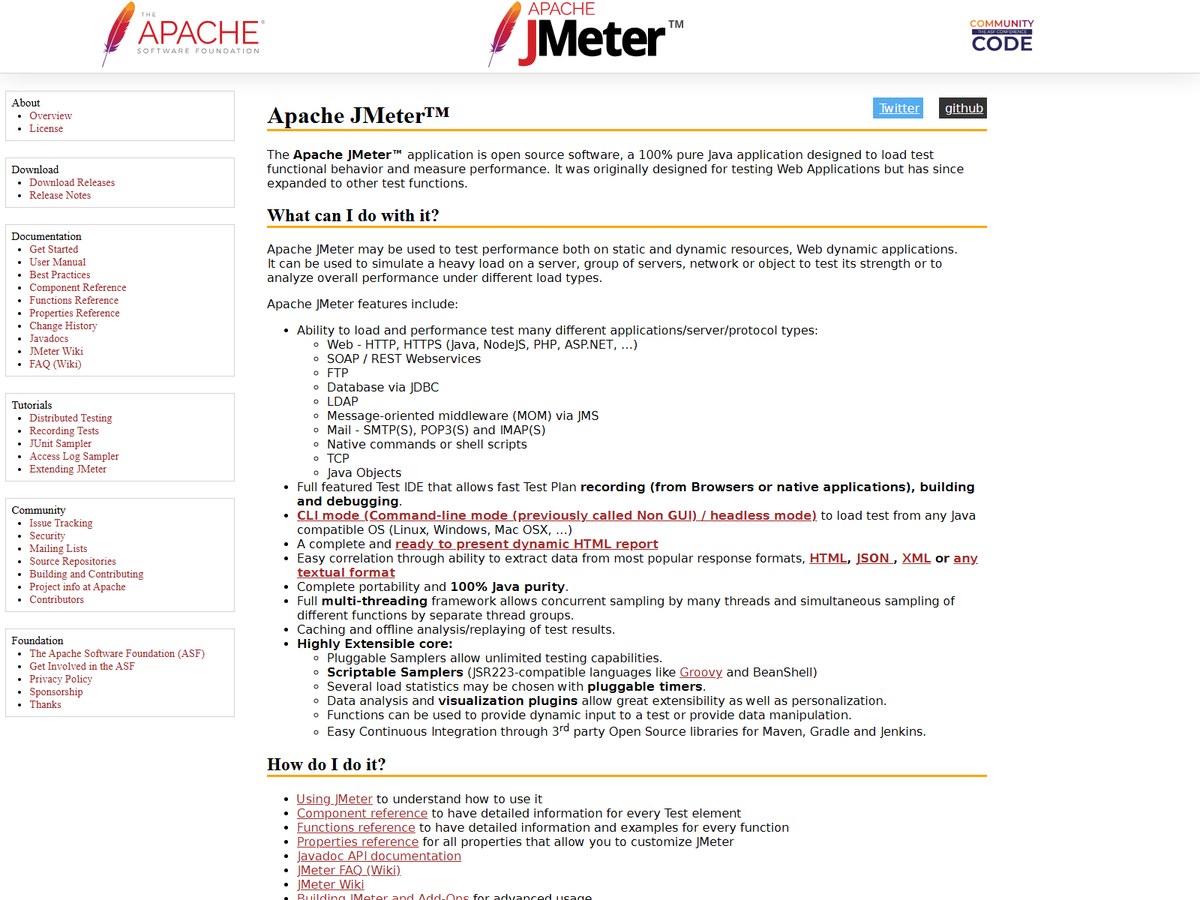
Apache JMeter has 9,604 GitHub stars and is the veteran of load testing: an open-source Java application from the Apache Software Foundation designed to measure performance and load test applications. It can simulate a heavy load on a server, group of servers, network or object to test its strength under different load types. JMeter's big strength is breadth: it tests web apps over HTTP and HTTPS, SOAP and REST web services, FTP, databases via JDBC, LDAP, JMS messaging, SMTP, POP3 and IMAP mail, TCP, Java objects and shell scripts. A full-featured test IDE lets you record test plans from browsers or native applications, then build and debug them, and a headless command-line mode runs tests on Linux, Windows or Mac. It produces ready-to-present dynamic HTML reports. JMeter is 100% Java and licensed under Apache 2.0.

Best forQA teams testing many protocols with a GUI test builder
Skip it ifYou prefer lightweight tests written as code

Source: github.com/apache/jmeter

8
Artillery by Artillery
Image: Artillery (official site)

Artillery

Artillery · Load testing and Playwright testing platform

9,122 GitHub stars

The serverless, cloud-scale load tester.

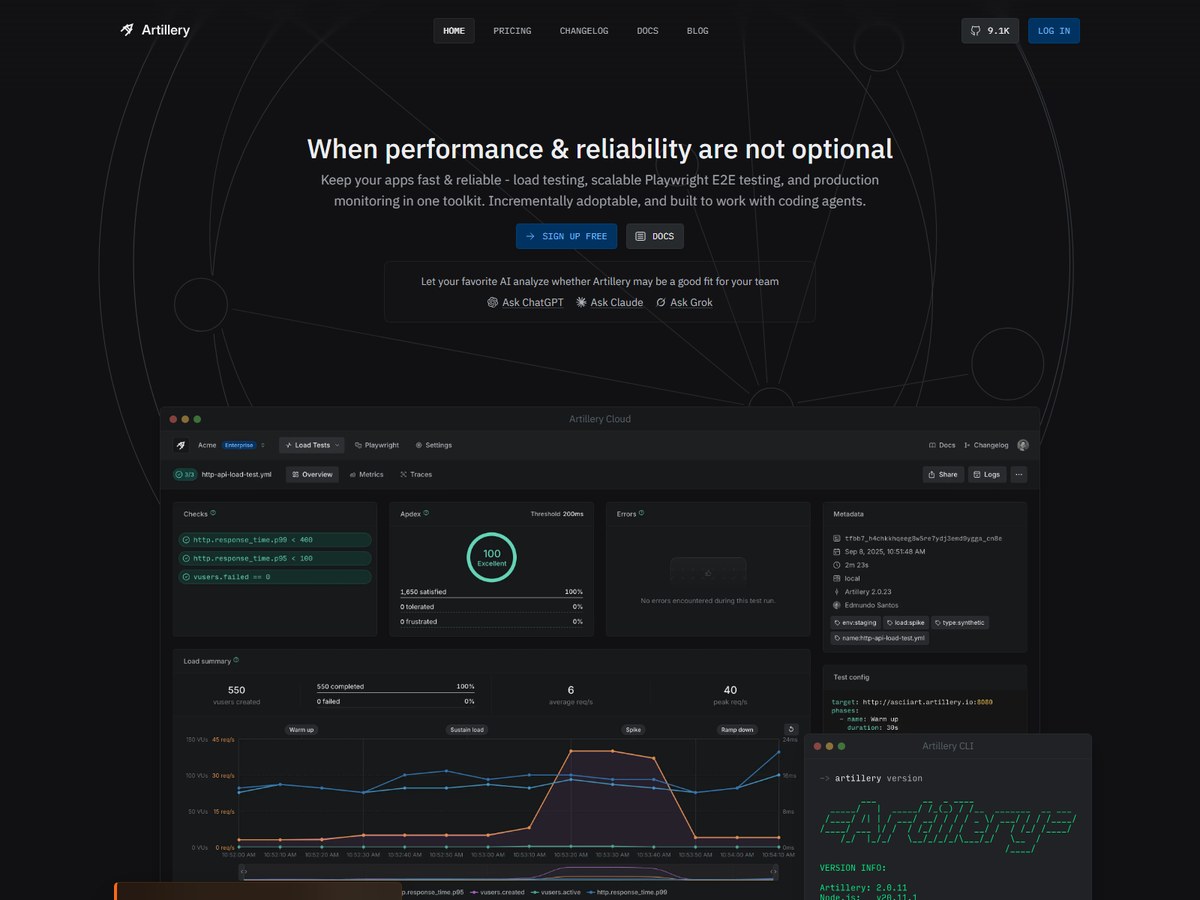
Artillery has 9,122 GitHub stars and calls itself the complete load testing platform. Its standout feature is cloud-scale testing out of the box and for free: you scale out load tests on AWS Lambda or AWS Fargate with no DevOps and zero infrastructure to manage. Artillery can also load test with real headless browsers using Playwright, and it tests HTTP, WebSocket, Socket.io, gRPC, Kinesis and more. Workload modeling lets you emulate complex user behavior with request chains, multiple steps and transactions, and it has 20+ integrations for monitoring, observability and CI/CD plus a plugin API. Its homepage says Artillery combines load testing, scalable Playwright end-to-end testing and production monitoring in one toolkit built to work with coding agents. Most of the code is MPL 2.0, while some Azure modules use the BSL and need a commercial license for production use.

Best forTeams that want serverless, distributed load tests and Playwright browser tests
Skip it ifYou need a permissive license for commercial use on Azure

Source: github.com/artilleryio/artillery

9
Gatling by Gatling
Image: Gatling (official GitHub repository)

Gatling

Gatling · Load testing as code in Java, JavaScript, TypeScript, Kotlin or Scala

6,961 GitHub stars

Efficient load testing as code for the JVM.

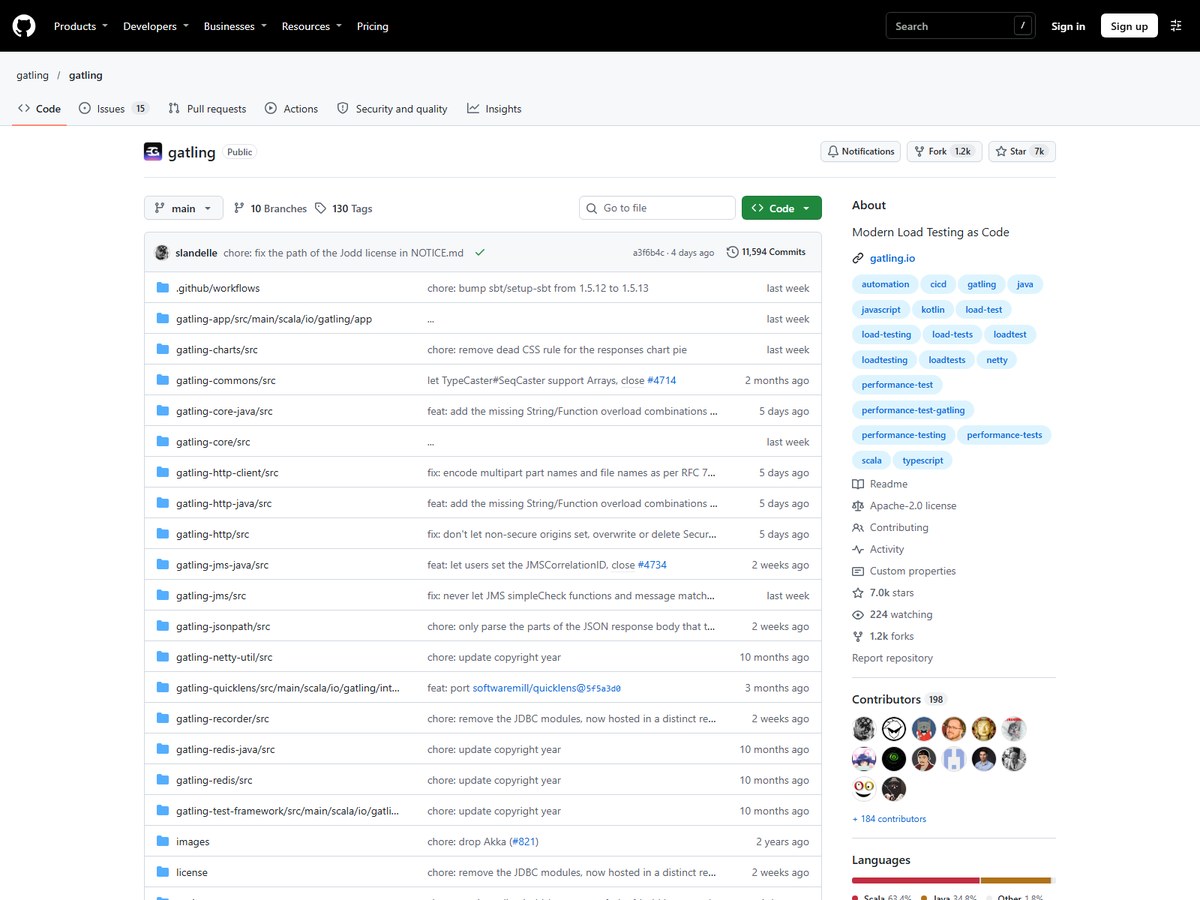
Gatling has 6,961 GitHub stars but by far the biggest published user base on this list: its README cites 300,000+ companies and 30M+ downloads. It is an open-source load testing tool where you write test scenarios, called simulations, as code in Java, JavaScript, TypeScript, Kotlin or Scala, run them against your services and get a detailed HTML report of response times, throughput and errors. You can run tests on your machine or in CI through Maven, Gradle, sbt or npm plugins, and fail the build when performance regresses. Its engine is efficient: virtual users are lightweight messages on a non-blocking engine built on Netty rather than operating system threads, so you need far fewer load generators. Gatling Community Edition is Apache 2.0 and free to use commercially, with no cap on test duration or virtual users; an Enterprise Edition is also available.

Best forJava and JVM teams that want efficient load tests in CI
Skip it ifYou want a no-code test builder

Source: github.com/gatling/gatling

10
bombardier by bombardier open-source project
Image: bombardier (official GitHub repository)

bombardier

bombardier open-source project · Fast cross-platform HTTP benchmarking tool in Go

6,856 GitHub stars

A fast, cross-platform benchmark in Go.

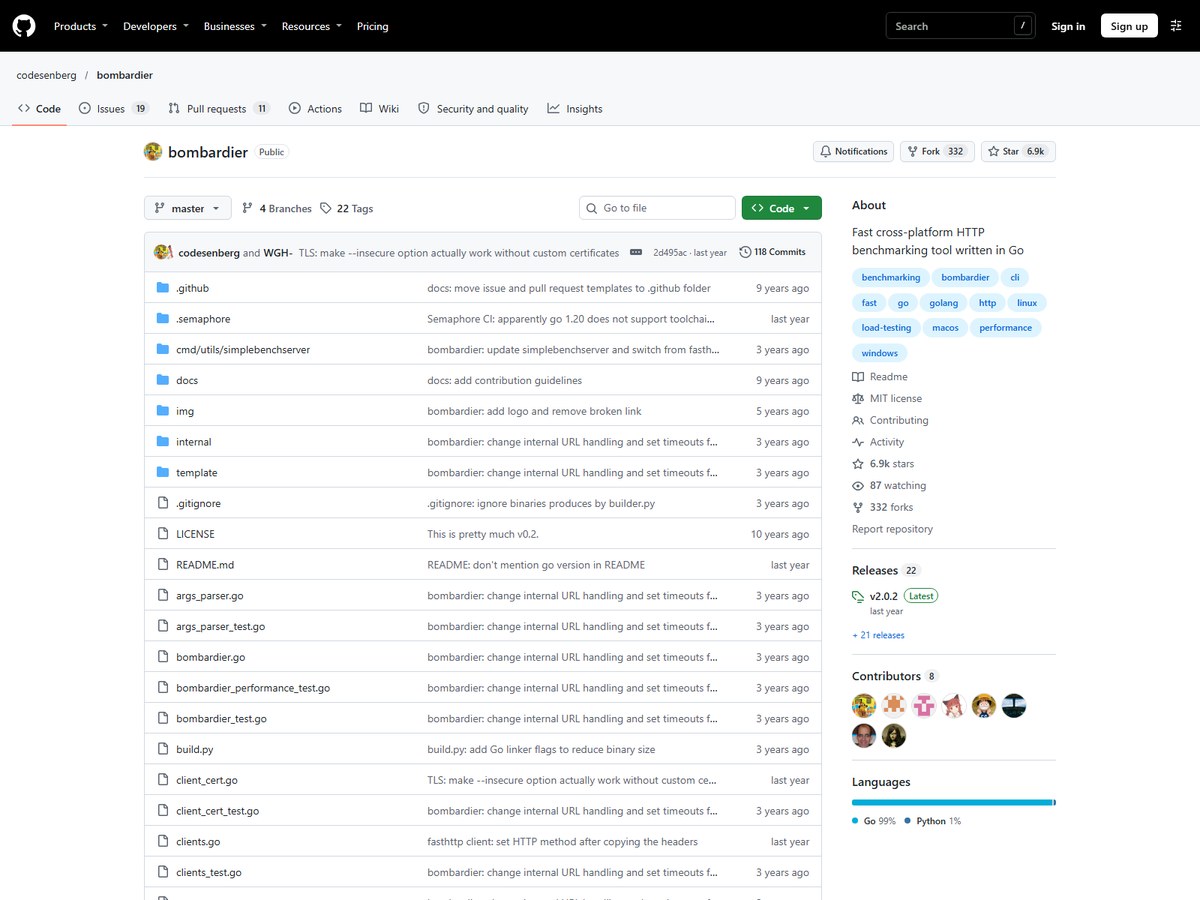
bombardier rounds out the list with 6,856 GitHub stars. It is an HTTP(S) benchmarking tool written in Go, and its GitHub description calls it a fast cross-platform HTTP benchmarking tool. Its speed comes from fasthttp, which the project uses instead of Go's default HTTP library because of its lightning fast performance. From version 1.1 you can switch to the standard net/http client when you need to test HTTP/2 services or want a more RFC-compliant client. You can download binaries from the releases section or install it with go install on Go 1.18 or later. bombardier can print a latency distribution, which helps you see slow outliers rather than just averages. Like wrk and hey, it is a command-line benchmark for hitting endpoints hard rather than a full scenario-testing suite. It is open source under the MIT license.

Best forDevelopers who want a fast, single-binary benchmark on any OS
Skip it ifYou need scripted scenarios or reports for stakeholders

Source: github.com/codesenberg/bombardier

Questions people ask

What is the best load testing tool?

wrk is the most-starred, with 40,423 GitHub stars, for raw HTTP benchmarks. For full test scenarios, Grafana k6 (32,308 stars) is the top pick for JavaScript and Locust (28,288 stars) for Python.

What is the difference between load testing and benchmarking tools?

Benchmarking tools like wrk, hey, oha and bombardier fire as many requests as possible at one endpoint. Load testing tools like k6, Locust, Gatling and JMeter script realistic user journeys with many steps, users and reports.

Which load testing tool is best for Python?

Locust lets you write load tests in plain Python, runs thousands of concurrent users per process and has a real-time web UI.

Are these load testing tools free?

Yes, all ten have free open-source editions. k6 uses the AGPL-3.0 license; Artillery is mostly MPL 2.0 with some BSL-licensed Azure modules; the others use MIT, Apache 2.0 or similar licenses.

How were these load testing tools ranked?

By GitHub stars on each project's official repository, read November 15, 2026.

How we ranked

GitHub stars on each project's official repository, read November 15, 2026. Stars measure developer interest, not paying customers or production use, so treat them as a guide to popularity. Gatling separately reports 300,000+ companies using it. Every number on this page comes from the source linked under each pick, and every photo shows the actual product. Brands can't pay to be on this list.

List source: github.com/wg/wrk · Updated 2026-11-15