1Password is the largest business password manager, used by over 200,000 businesses, with its Business plan at $8.99 per user a month. Keeper, LastPass and Proton Pass each say 100,000+ customers, organizations or businesses use them, and Bitwarden follows with over 80,000 businesses and plans from $4 per user. For self-hosting, Bitwarden, Passbolt and Psono are the open-source options.
How it's ranked: Businesses, organizations or customers each vendor says use it, as published on its own website (read November 2026). Keeper, LastPass and Proton Pass each state 100,000+ and are listed alphabetically, as are Passbolt and RoboForm at 50,000+. Keeper's figure is for customers, Proton's 100,000+ businesses is shown on its Proton Pass for Business page, Passbolt's 50,000+ organisations includes users of its free edition, and Dashlane counts brands. Psono and Zoho Vault publish no customer count, so they are ranked last, in alphabetical order. Counts are each company's own claims and are measured differently, so treat them as a guide to scale, not an audit. Prices are per user per month on annual billing, from each vendor's pricing page.
1Password · Business password manager with SSO, SIEM and developer tools
200,000+ businesses
The most widely used business password manager.
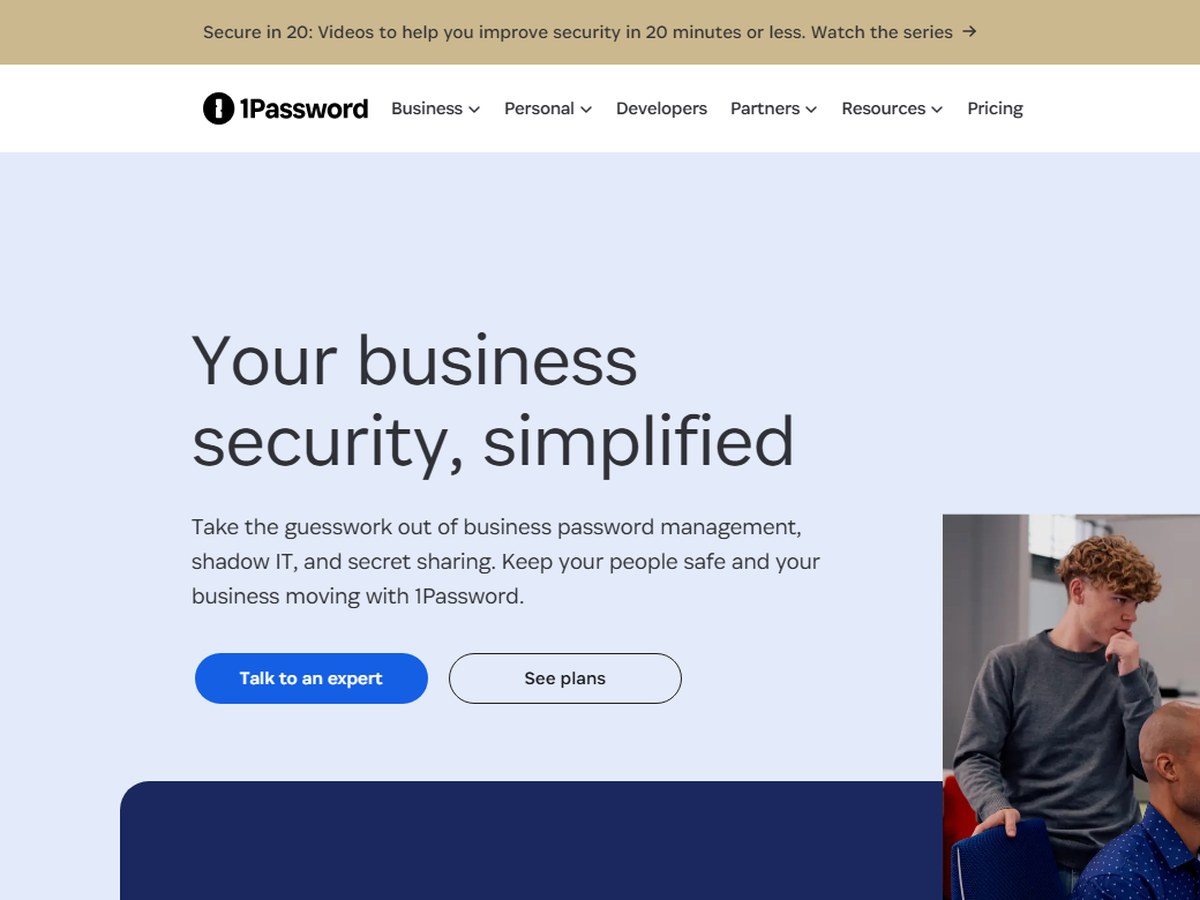
1Password says over 200,000 businesses trust it, the largest count on this list, with logos such as Canva, Slack, IBM, Stripe and Reddit on its pricing page. The Business plan costs $8.99 per user a month billed yearly, with a one-user minimum, and connects to Okta, Entra ID, OneLogin and Duo for single sign-on. It adds Watchtower alerts for weak, reused and breached passwords, custom reports, role-based vault permissions and event streaming to SIEM tools such as Splunk and Elastic. Every user also gets a free Families plan for personal use. Small teams can pick the Teams Starter Pack at $24.95 a month billed yearly for 10 members, with up to 10 extra seats at $4.99 each. Both plans have a 14-day free trial, and 1Password holds SOC 2 Type II certification. Organizations with 101+ users get personalized training and a dedicated Customer Success Manager.
Best forGrowing companies that want a polished password manager staff will actually use
Skip it ifYou need the lowest possible price per seat
Keeper Security · Password manager plus privileged access management
100,000+ customers
Best for compliance-heavy organizations.
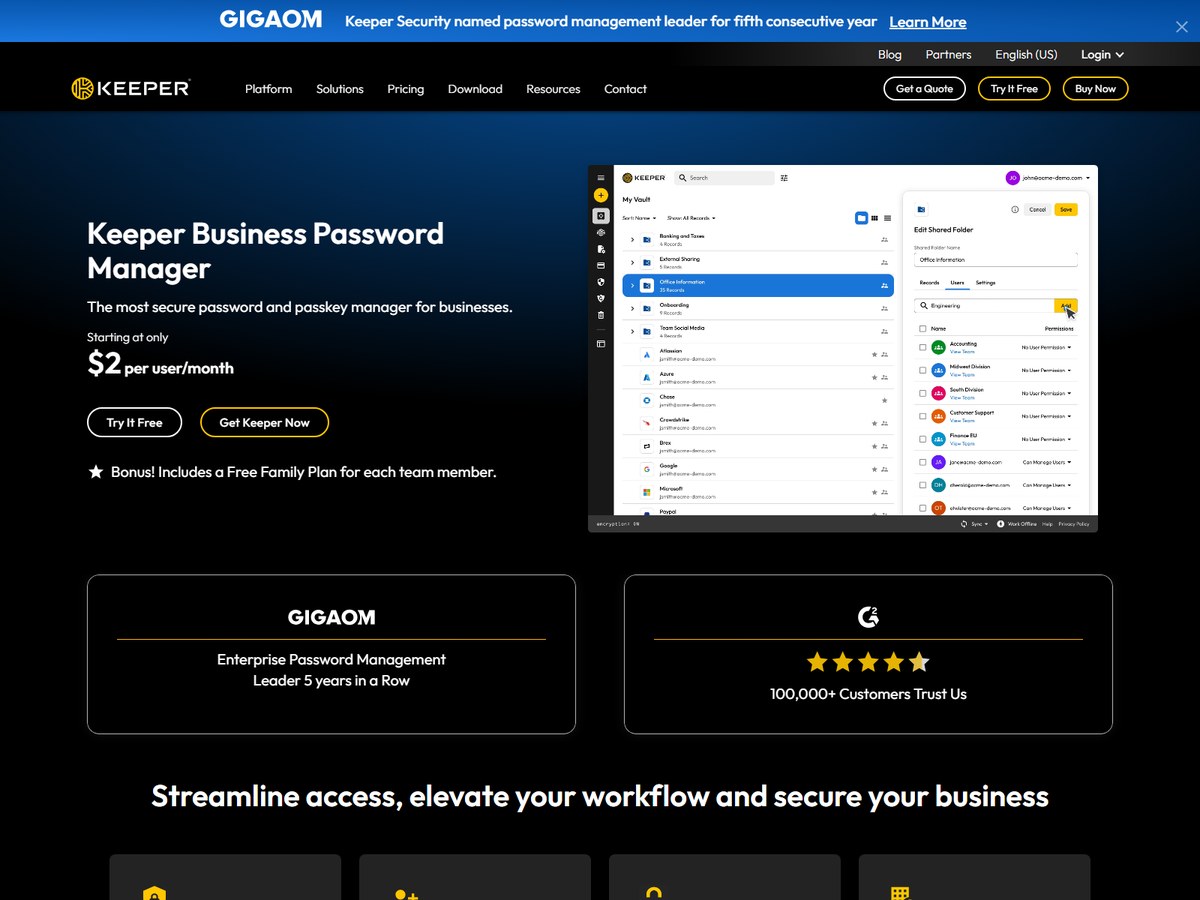
Keeper says 100,000+ customers trust it, and it holds FedRAMP High and GovRAMP High authorization, FIPS 140-3 validation, ISO 27001, 27017 and 27018 certification and SOC 2 Type II audits. Vaults use zero-knowledge encryption, so data is encrypted on the device before it reaches Keeper's servers. Business Starter costs $2.00 per user a month billed annually for teams of 5 to 10 users, with a minimum of 5 seats. Business costs $4.00 and adds shared team folders, delegated administration and a free Family Plan for every user. Enterprise costs $6.00 and adds SCIM, AD/LDAP and SSO/SAML provisioning, advanced two-factor authentication, role-based access control and developer APIs. Keeper also sells KeeperPAM for privileged access, secrets management and remote access at custom pricing. All business users get 24x7 support by live chat and email. It fits security-minded IT teams.
Best forRegulated organizations and government contractors that need strong certifications
Skip it ifYou only want a simple vault for a handful of people
LastPass · Browser-based password and access management
100,000+ organizations
A long-running choice for small and mid-size businesses.
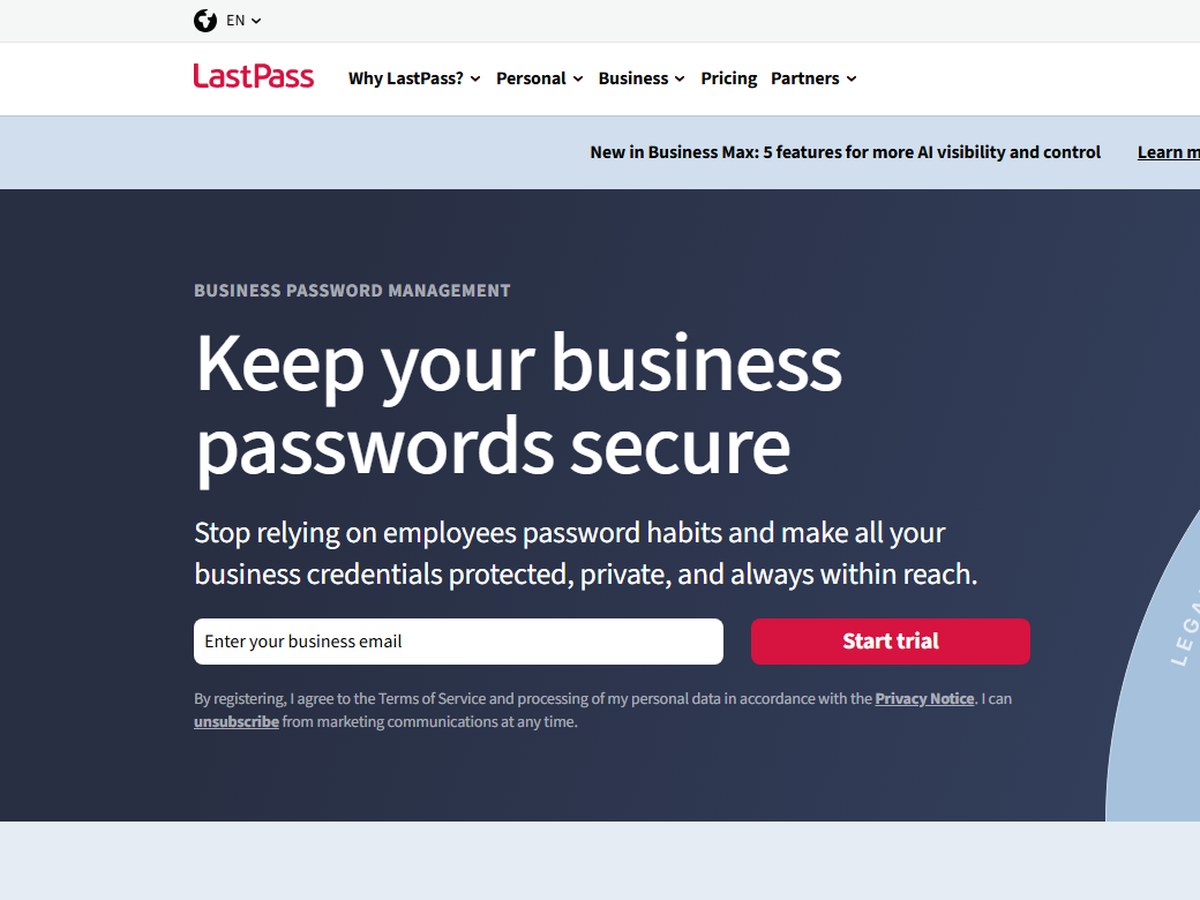
LastPass says more than 100,000 organizations and millions of people use it to store passwords and passkeys, share credentials across teams, enforce multifactor authentication and manage employee access from one Admin Console. It was founded in 2008 and is headquartered in Boston; LogMeIn (now GoTo) bought it for $110M in 2015, and it formally separated from GoTo in 2024. Vault data is encrypted with AES-256 on the user's own device. Teams costs $4.25 per user a month billed annually for up to 50 users. Business costs $7.00 with unlimited users, 100+ advanced security policies, group management and LastPass Families for every employee. Business Max costs $11.00 and adds monitoring of AI tools, SaaS apps and web use, single sign-on for an unlimited number of apps instead of three, and advanced MFA. Every business plan has a 14-day free trial.
Best forSmall and mid-size businesses that want a familiar, browser-first tool
Proton · End-to-end encrypted, open-source business password manager
100,000+ businesses
Best low-cost, privacy-first pick.
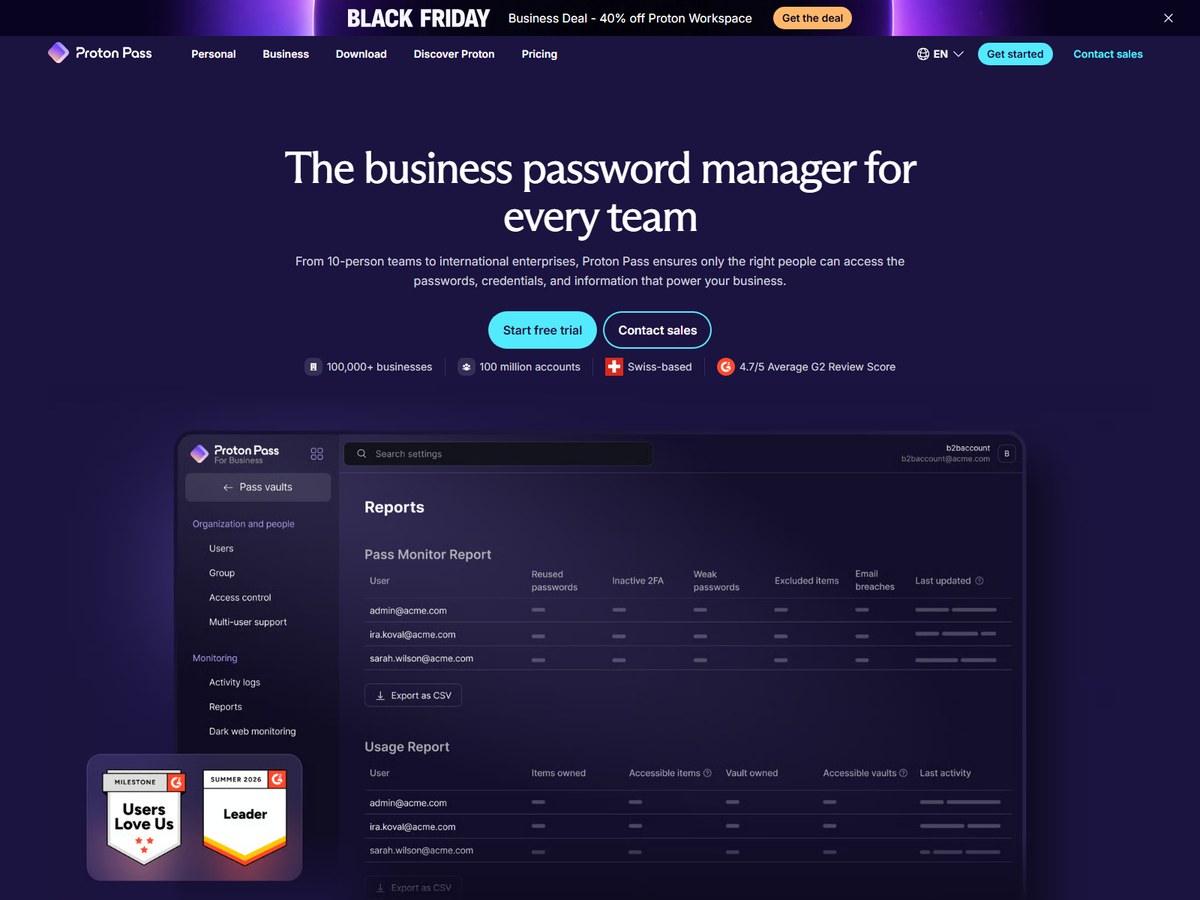
Proton says on its Proton Pass for Business page that 100,000+ businesses and 100 million accounts use Proton, a Swiss-based company with a 4.7/5 average G2 score. Proton Pass is open source and end-to-end encrypted. Pass Essentials costs $1.99 per user a month billed yearly ($23.88 a year) for teams of 3 to 30 users, with unlimited logins, vault and link sharing, a built-in 2FA authenticator, dark web monitoring, passkey support and unlimited hide-my-email aliases. Pass Professional costs $4.99 per user a month billed yearly ($59.88) for 3 users and more, adding SSO and SCIM, detailed activity logs, enterprise policies, SIEM integration, group sharing, a command line interface and an SSH agent. Both plans have a 14-day free trial. Proton also sells a combined VPN and Pass Professional plan. It fits teams that already use Proton Mail or care most about privacy.
Best forPrivacy-focused teams that want aliases and a low entry price
Bitwarden · Open-source password manager, cloud or self-hosted
80,000+ businesses
Best value and best open-source pick.
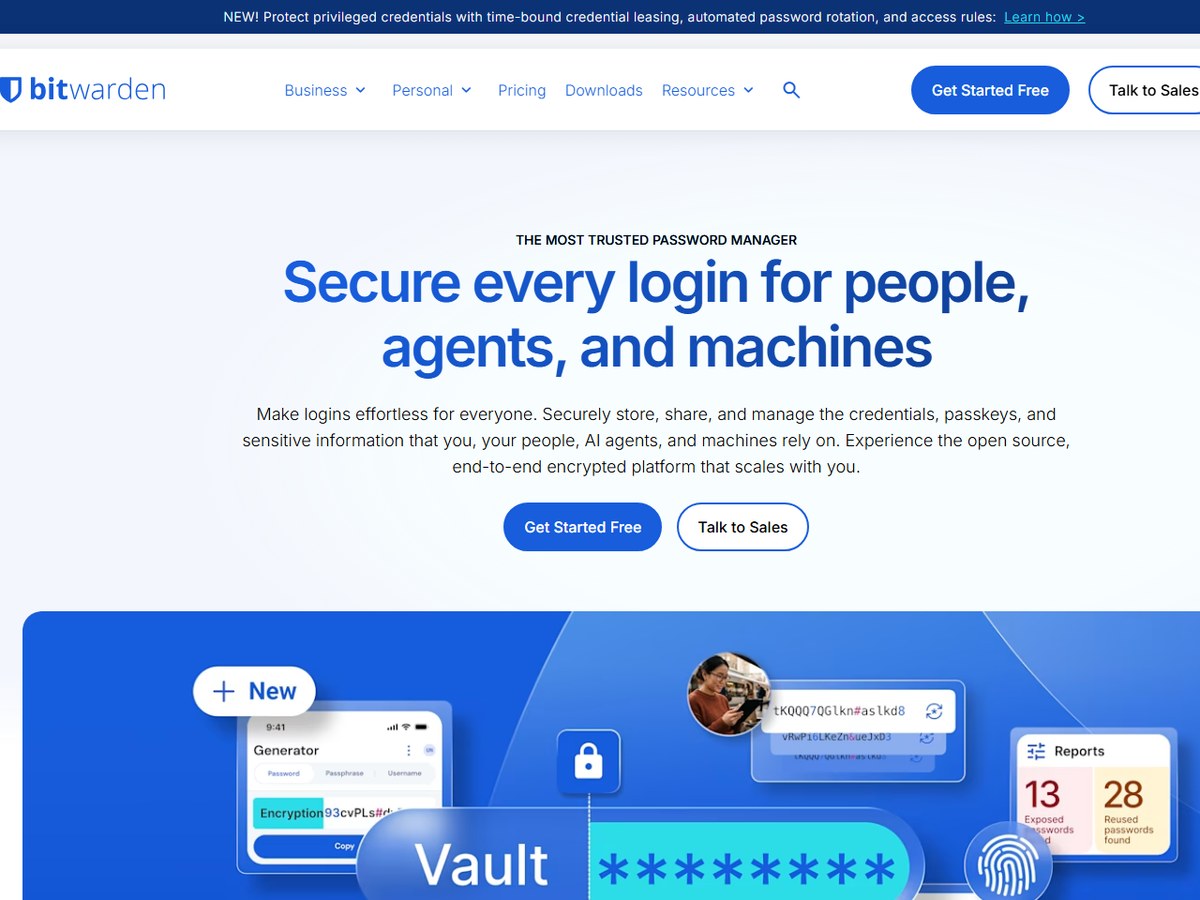
Bitwarden says it serves over 80,000 businesses and more than 15 million users in over 180 countries and 50+ languages. Founded in 2016 and headquartered in Santa Barbara, California, it takes an open source approach, so its code can be inspected, and uses zero-knowledge encryption. The Teams plan costs $4 per user a month billed annually and covers secure credential sharing, event logs for auditing, directory sync and SCIM provisioning. Enterprise costs $6 per user a month and adds granular access control, passwordless SSO, enterprise policies, the option to self-host and Access Intelligence risk remediation, plus a free Families plan for every user. Large organizations can request a quote. Both business plans have a free trial, every account gets unlimited devices and passwords, and Bitwarden also sells Secrets Manager for developers. It fits budget-minded businesses that want transparency.
Best forCost-conscious companies and IT teams that value open source or self-hosting
Skip it ifYou want the most polished consumer-style design
Passbolt · Open-source, self-hosted or cloud credential manager for teams
50,000+ organisations
Best for self-hosting with team sharing.
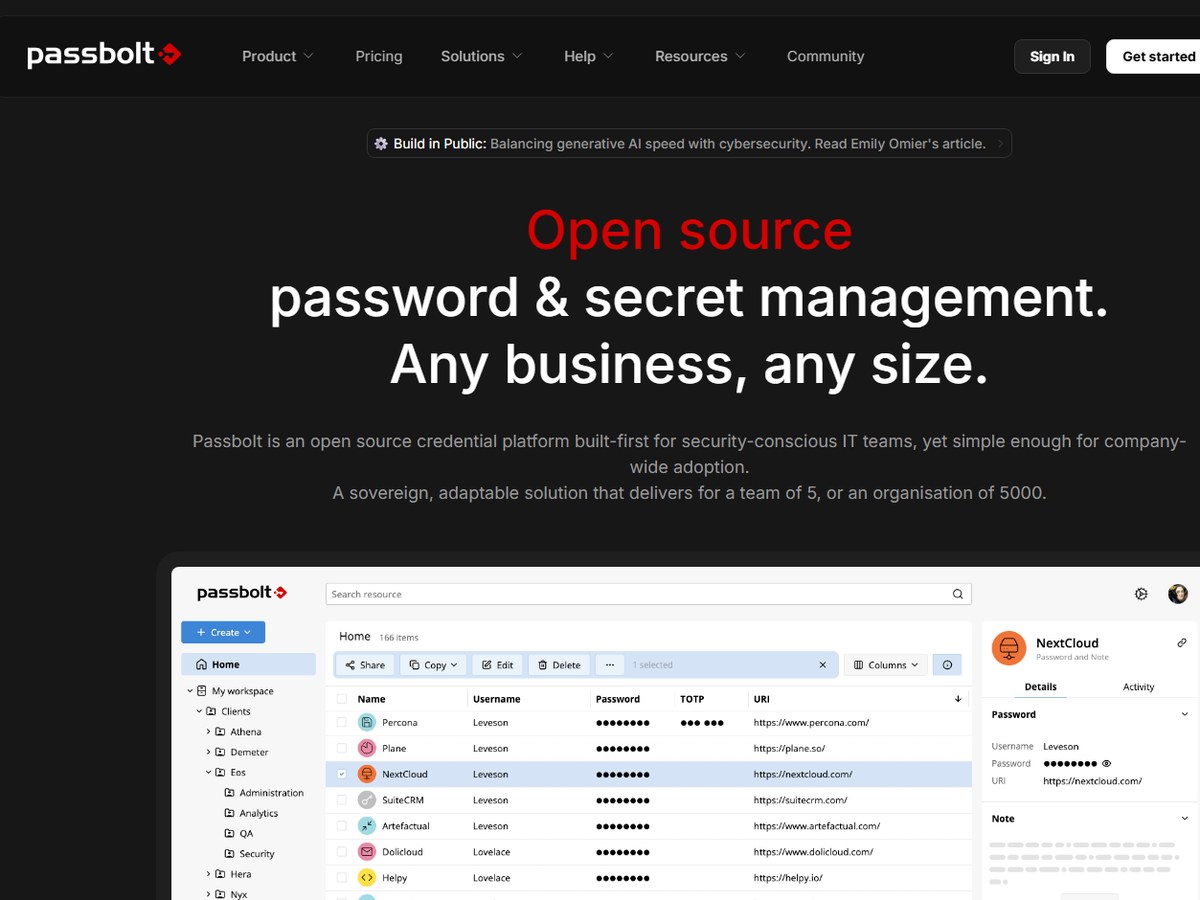
Passbolt says 50,000+ organisations worldwide use it, including governments, defence agencies and IT companies such as Bosch. Its about page says it had 2,000 paying customers when it closed an $8M funding round in 2024. Passbolt is open source all the way, even the paid version, and it can be self-hosted or cloud-hosted. Secrets are encrypted on the client side, it holds a SOC 2 Type II report, and it says 100% of its source code has been audited. The Community Edition is free for unlimited users under the AGPLv3 license, with sharing, folders, role-based access control and a CLI. The Pro Edition costs $4.9 per user a month billed annually, with a minimum of 10 users and volume discounts after 100, and adds LDAP provisioning, single sign-on with Microsoft, Google and OpenID, account recovery and activity logs. Enterprise is quoted with a 4-hour support SLA.
Best forIT and DevOps teams that want to host their own password server
Skip it ifYou want a large consumer-style feature set
Siber Systems · Password manager and form filler for teams
50,000+ organizations
Best budget pick for small businesses.
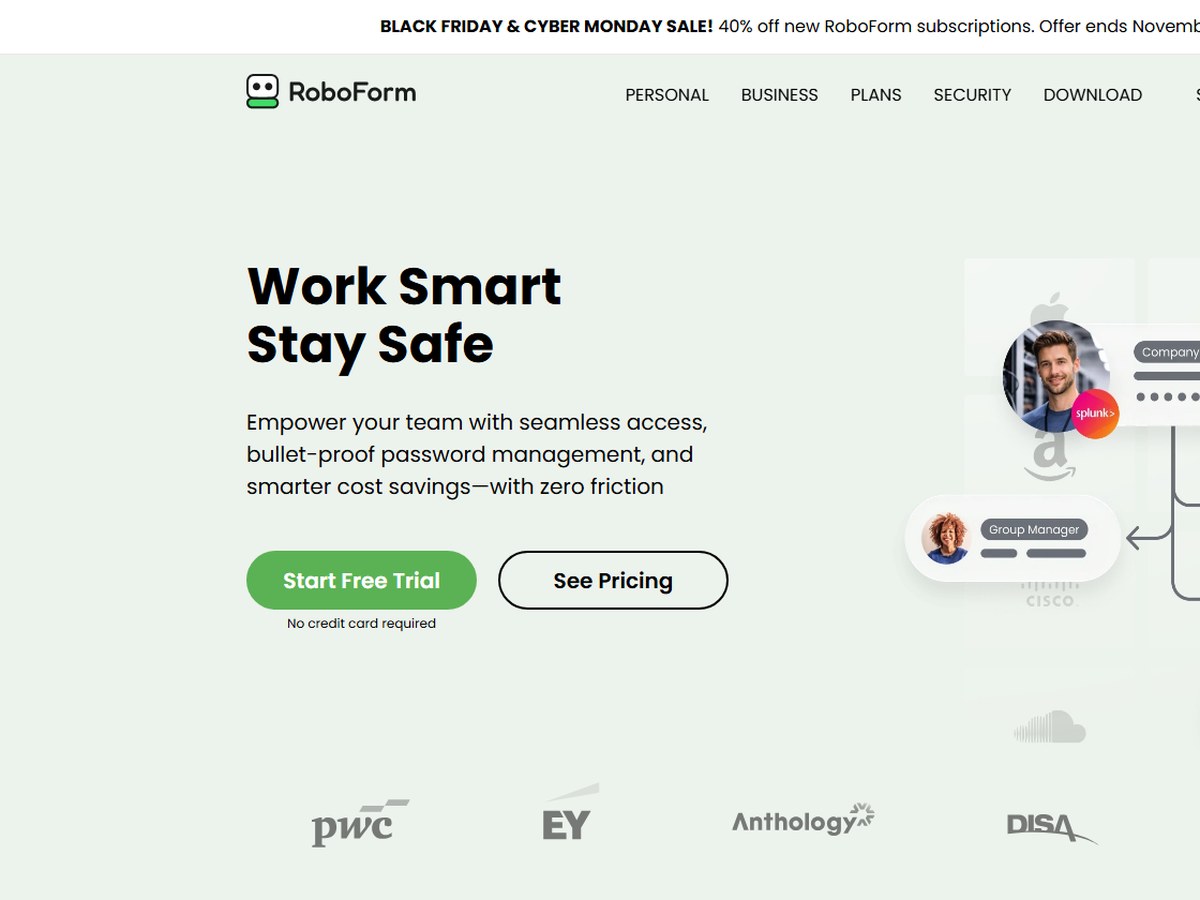
RoboForm says 50,000+ organizations trust it, and it scales from 10 users to 10,000. It is made by Siber Systems of Fairfax, Virginia. The Business plan costs $3.33 per user a month billed annually; a Black Friday and Cyber Monday sale cut that to $2.00 for new subscriptions until November 30. The plan includes separate personal and work vaults, central management from an admin center, secure and granular sharing, single sign-on, SCIM provisioning, custom security policies, role-based access control, dark web monitoring, detailed activity logs and audit reports. Accounts with 10+ paid licenses also get a RoboForm Family plan for up to 5 personal accounts, and support runs 24/7. The Enterprise plan adds volume pricing, dedicated onboarding engineers, a custom SLA and a self-hosting option for 1,000+ user environments. It fits budget-minded small businesses that want a free trial before they buy.
Best forSmall and mid-size businesses that want a low price and simple admin
Skip it ifYou need deep developer or privileged access tools
Dashlane · Credential security platform with password management
25,000+ brands
Best for credential-risk detection.
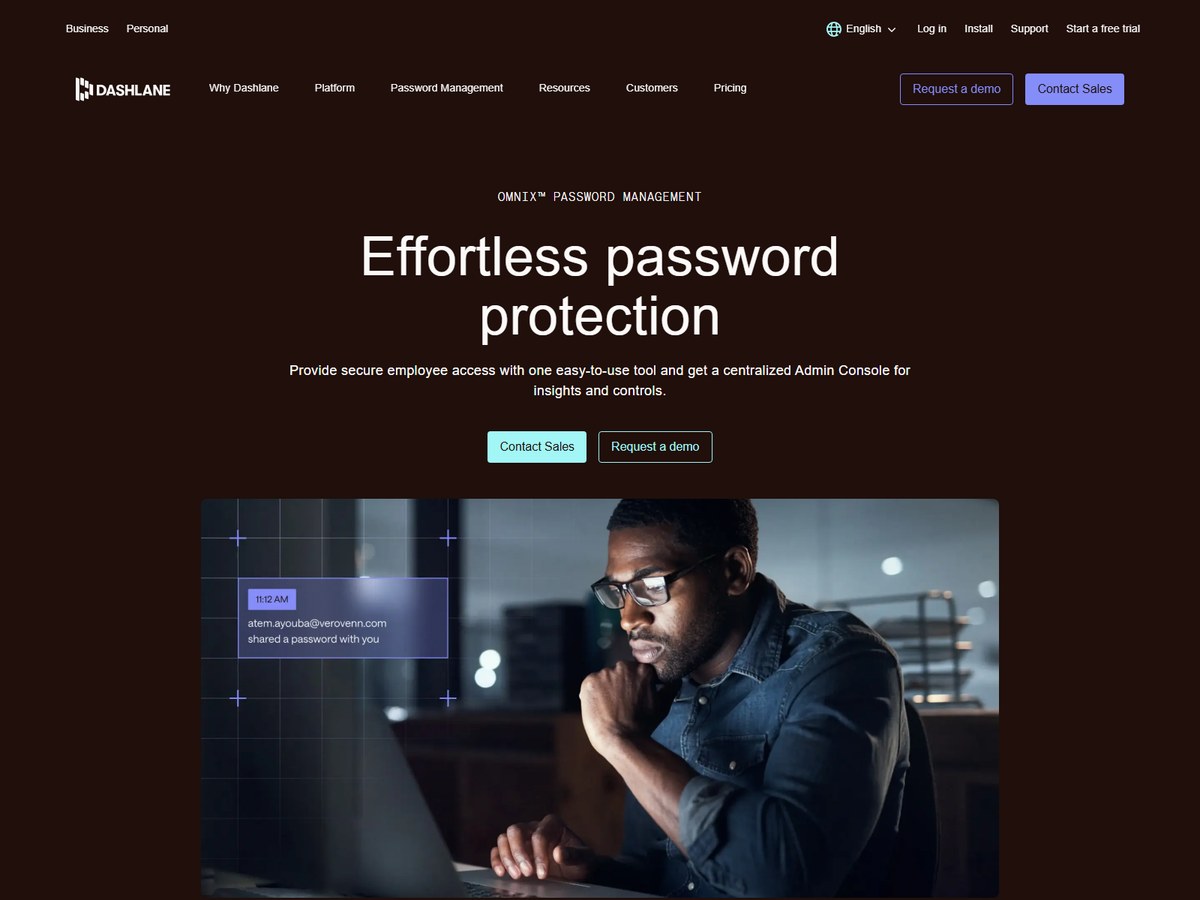
Dashlane says over 25,000 brands worldwide trust it, including Michelin, Air France and Forrester. Its business products run on the Dashlane Omnix platform, which combines password management with credential protection. Omnix Password Management costs $8 per user a month billed annually and comes with a 14-day free trial; it protects employee passwords and passkeys, shares workforce passwords, enforces password policies and connects to SSO and SCIM. Omnix Credential Protection costs $4 per user a month billed annually and detects credential risks and phishing in the browser, including for domains outside SSO. Omnix Enterprise is built for organizations with more than 50 users and is priced by quote, bundling both packages with dedicated account management. Dashlane stores business passkeys in secure enclaves instead of on the device and keeps encrypted audit logs of sharing. It fits security teams that want risk alerts as well as a vault.
Best forSecurity teams that want phishing and credential-risk alerts alongside the vault
esaqa GmbH · Open-source, self-hosted password manager for companies
No customer count published (2 million+ downloads)
Best free option for small self-hosting teams.
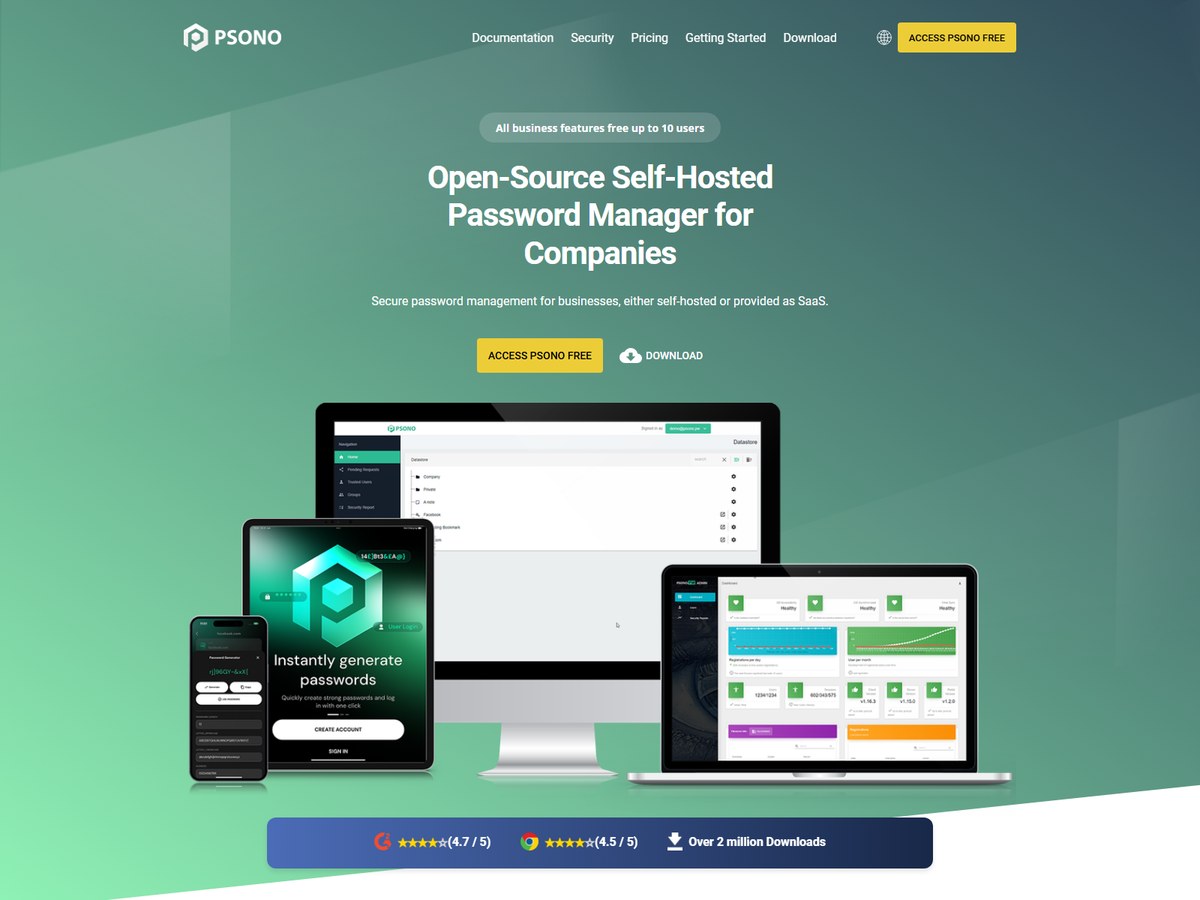
Psono does not publish a customer count, so it is ranked after the vendors that do, but it says it has over 2 million downloads. It is an open-source, self-hosted password manager for companies, made by esaqa GmbH in Germany, and it is also offered as SaaS. Vault data is encrypted on the client before it is stored, followed by transport and storage encryption, and the whole codebase can be audited publicly. The Community edition is free and open source with unlimited users. A free business version gives teams of up to 10 users the complete feature set, including LDAP, SAML and OIDC single sign-on, audit logging, policies, compliance enforcement and a gateway for SSH, RDP and VNC. For larger companies the business version costs $3 per user a month billed annually, with a minimum of 25 users. Apps run on macOS, Windows, Linux, iOS and Android.
Best forSmall IT teams that want a free self-hosted vault
Skip it ifYou want a fully managed service with big-brand support
Zoho · Password and passkey manager for teams and enterprises
No customer count published (thousands of businesses)
Best low-cost pick for Zoho and Microsoft 365 shops.
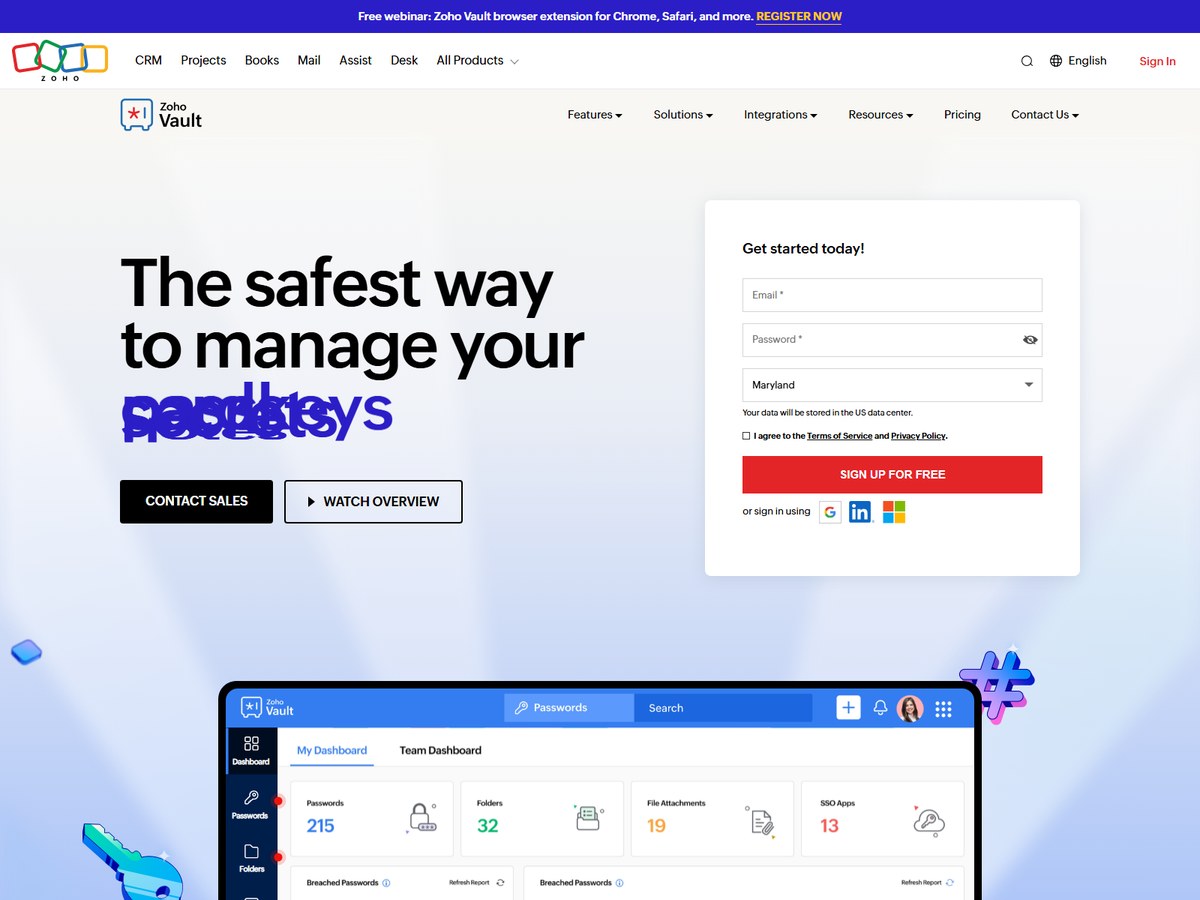
Zoho Vault does not publish a customer count, so it is ranked after the vendors that do; its customers page says it is trusted by thousands of businesses worldwide. It runs on a zero-knowledge, SOC 2-certified platform with AES-256 encryption and was named a Leader and Fast Mover in the 2025 GigaOm Radar for Enterprise Password Management. A free-forever plan covers unlimited passwords, passkeys and devices. Standard costs US$0.90 per user a month billed annually and adds team sharing, centralized admin controls and Google Workspace and Microsoft 365 integration. Professional costs US$4.50 with a minimum of 5 users and adds user groups, shared folders, breached password alerts and a CLI. Enterprise costs US$7.20 with a minimum of 5 users and adds Active Directory, single sign-on for cloud apps, Okta and OneLogin integration and SIEM integration. There is a 15-day free trial with no credit card required.
Best forBusinesses already using Zoho, Google Workspace or Microsoft 365
1Password is the most widely used, with over 200,000 businesses. Keeper is the strongest pick for regulated organizations, with FedRAMP High authorization, and Bitwarden offers the best value among open-source tools at $4 per user a month.
What is the cheapest business password manager?
Among paid plans, Zoho Vault Standard costs US$0.90 per user a month and Proton Pass Essentials $1.99, both billed yearly. Keeper Business Starter costs $2.00 for 5 to 10 users. Passbolt Community Edition and Psono Community are free, and Psono is free with business features for up to 10 users.
Which business password managers can be self-hosted?
Bitwarden Enterprise, Passbolt and Psono can be self-hosted, and all three are open source. RoboForm Enterprise offers self-hosting for environments of 1,000+ users.
Do business password managers include a personal plan for employees?
1Password Business, Bitwarden Enterprise, Keeper Business and LastPass Business include a free family or personal plan for each user. RoboForm includes a Family plan for accounts with 10+ paid licenses.
How were these password managers ranked?
By the number of businesses, organizations or customers each vendor publishes on its own website. These are the companies' own claims. Vendors that publish no count are ranked last.
How we ranked
Businesses, organizations or customers each vendor says use it, as published on its own website (read November 2026). Keeper, LastPass and Proton Pass each state 100,000+ and are listed alphabetically, as are Passbolt and RoboForm at 50,000+. Keeper's figure is for customers, Proton's 100,000+ businesses is shown on its Proton Pass for Business page, Passbolt's 50,000+ organisations includes users of its free edition, and Dashlane counts brands. Psono and Zoho Vault publish no customer count, so they are ranked last, in alphabetical order. Counts are each company's own claims and are measured differently, so treat them as a guide to scale, not an audit. Prices are per user per month on annual billing, from each vendor's pricing page. Every number on this page comes from the source linked under each pick, and every photo shows the actual product. Brands can't pay to be on this list.

 Keeper100,000+ customers
 LastPass Business100,000+ organizations