consumertop10

Home › Software

Top 10 · Software

Top 10 Static Site Generators

The tools developers use to turn Markdown and templates into fast, secure websites, ranked by GitHub stars.

Quick answer

Hugo is the most popular static site generator, with 90,476 GitHub stars: it is written in Go and renders a complete site in seconds. Docusaurus is second with 66,746 stars and is the standard for documentation sites, and Astro is third with 63,968 stars for fast, content-driven websites. Gatsby, Jekyll and Hexo follow.

How it's ranked: GitHub stars on each project's official repository, read November 15, 2026. Stars measure developer interest, not how many live sites use each tool, so treat them as a guide to popularity.

1
Hugo by Hugo open-source project
Image: Hugo (official site)

Hugo

Hugo open-source project · Static site generator written in Go

90,476 GitHub stars

The fastest, most popular static site generator.

Hugo is the most popular static site generator, with 90,476 GitHub stars, and its homepage bills it as "the world's fastest framework for building websites." It is written in Go and optimized for speed: with its templating system and fast asset pipelines, Hugo renders a complete site in seconds, often less. It has multilingual support and a powerful taxonomy system, and it is widely used for corporate, government, nonprofit, education and news sites, documentation, portfolios, landing pages, blogs and even resumes. Built-in pipelines handle CSS, Sass and Tailwind CSS processing, JavaScript and TypeScript bundling and image processing such as resizing and cropping. Hugo Modules let you share themes, templates and content across projects through Git. A deploy edition can push your site straight to Google Cloud Storage, AWS S3 or Azure Storage. Hugo is open source and free to use.

Best forAnyone who wants very fast builds and a single binary with no runtime to install
Skip it ifYou want to build pages from React or Vue components

Source: github.com/gohugoio/hugo

2
Docusaurus by Meta
Image: Docusaurus (official site)

Docusaurus

Meta · React-based generator for documentation websites

66,746 GitHub stars

The standard for documentation sites.

Docusaurus has 66,746 GitHub stars and is built for one job above all: documentation websites. Meta released it, saying it helps the company scale and support the many open-source projects at Meta. You write docs and blog posts in MDX, which lets you embed React components in Markdown, and Docusaurus builds them into static HTML files. Out of the box you get a home page, a docs section, a blog and support pages. Its standout features are document versioning, which keeps docs in sync with each release of your project, and localization, with translation through Git, Crowdin or any other translation manager. It also supports Algolia documentation search. You can try it in a playground at docusaurus.new. Docusaurus is MIT licensed, and version 3.10 is the latest release.

Best forOpen-source projects and companies building documentation sites
Skip it ifYou are building a marketing site or blog with no docs

Source: github.com/facebook/docusaurus

3
Astro by Astro
Image: Astro (official site)

Astro

Astro · Web framework for content-driven websites

63,968 GitHub stars

The best mix of speed and modern components.

Astro has 63,968 GitHub stars and calls itself "the web framework for content-driven websites." Its homepage says Astro powers the world's fastest marketing sites, blogs and e-commerce websites. It is server-first: Astro renders components on the server and sends lightweight HTML to the browser with zero unnecessary JavaScript. Astro supports every major UI framework, and its island architecture lets you bring React, Vue, Preact and other component libraries, and it can load content from your file system, an external API or your favorite CMS. It backs the speed claim with real-world data from the HTTP Archive and Chrome UX Report: 71% of Astro sites pass Core Web Vitals, compared with 48% for WordPress, 45% for Gatsby and 35% for Next.js. Astro 7.4 is the latest version.

Best forMarketing sites, blogs and stores that need top page speed
Skip it ifYou are building a highly interactive web app

Source: astro.build/

4
Gatsby by Netlify
Image: Gatsby (official site)

Gatsby

Netlify · React-based framework with static site generation

55,916 GitHub stars

A React powerhouse, now part of Netlify.

Gatsby is a free and open-source framework based on React, with 55,916 GitHub stars. It combines the control and scalability of dynamically rendered sites with the speed of static site generation. Gatsby can pull data from almost anywhere, including Markdown files, a headless CMS like Contentful or WordPress, or a REST or GraphQL API, through source plugins and one GraphQL interface. Rendering is flexible: alongside static site generation (SSG) you can choose Deferred Static Generation (DSG) or server-side rendering (SSR) page by page. Performance features such as code splitting, image optimization, inlining critical styles and lazy-loading are automatic. Gatsby is now part of Netlify: its site says Gatsby Cloud and Netlify Cloud are uniting, with migration paths for Gatsby Cloud customers. It is MIT licensed.

Best forReact developers pulling content from a headless CMS or APIs
Skip it ifYou want the lightest, simplest setup

Source: github.com/gatsbyjs/gatsby

5
Jekyll by Jekyll open-source project
Image: Jekyll (official site)

Jekyll

Jekyll open-source project · Blog-aware static site generator in Ruby

51,781 GitHub stars

The classic, and the engine behind GitHub Pages.

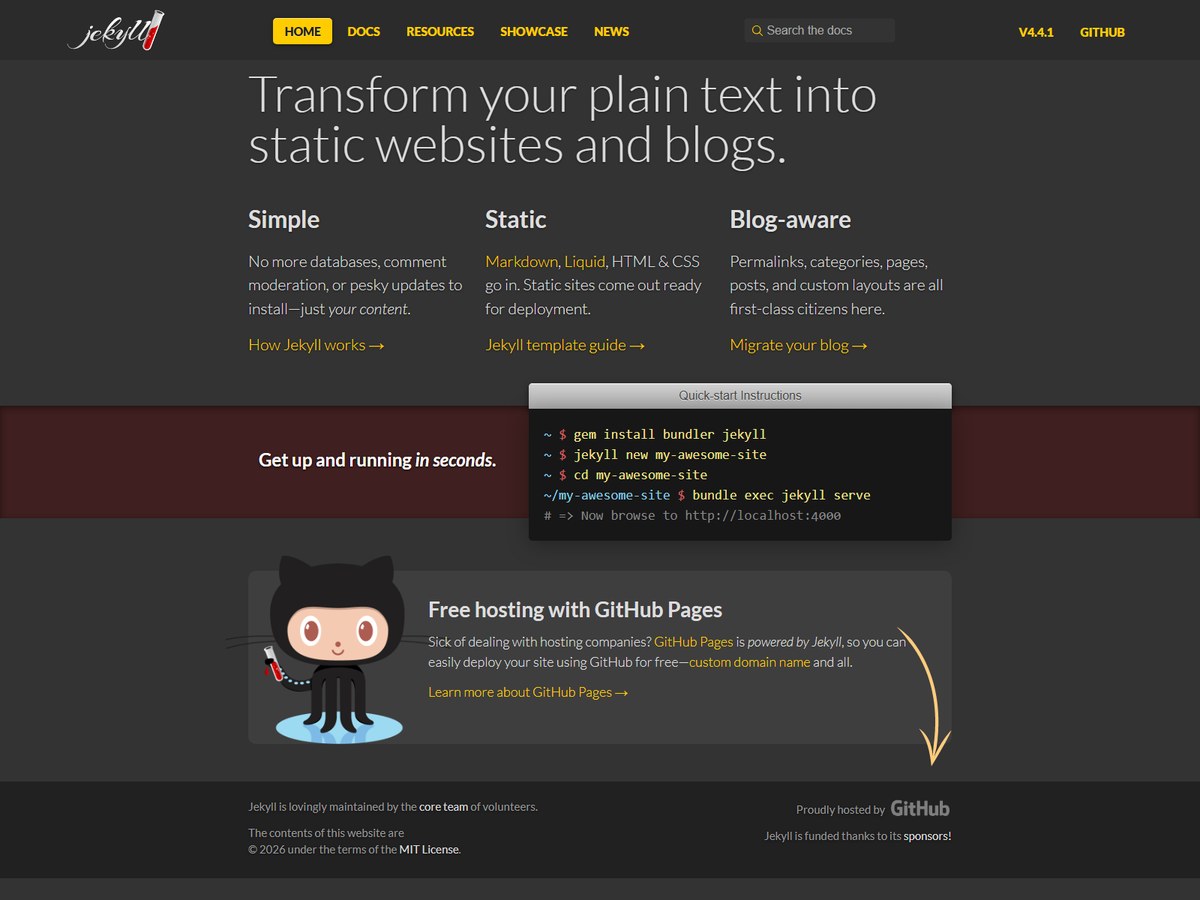
Jekyll is the original popular static site generator, with 51,781 GitHub stars. Its README calls it a simple, blog-aware static site generator for personal, project or organization sites; think of it like a file-based CMS without the complexity. Jekyll takes your content, renders Markdown and Liquid templates, and produces a complete static website ready for Apache, Nginx or another web server. Its biggest advantage is that Jekyll is the engine behind GitHub Pages, so you can host a site for free straight from a GitHub repository. Its homepage promises no more databases, comment moderation or pesky updates to install, and permalinks, categories, pages, posts and custom layouts are all built in. The project's philosophy is that Jekyll does what you tell it to do, no more, no less. It is written in Ruby, installs as a gem and is MIT licensed.

Best forBloggers and project sites hosted free on GitHub Pages
Skip it ifYou do not want to install Ruby

Source: github.com/jekyll/jekyll

6
Hexo by Hexo open-source project
Image: Hexo (official site)

Hexo

Hexo open-source project · Blog framework powered by Node.js

41,776 GitHub stars

The blogger favorite in the Node.js world.

Hexo has 41,776 GitHub stars and describes itself as "a fast, simple & powerful blog framework, powered by Node.js." Its homepage says hundreds of files take only seconds to build. Hexo supports all features of GitHub Flavored Markdown, including most Octopress plugins, which makes it easy to move an old blog over. Deployment is one command, to GitHub Pages, Heroku or other platforms. Plugins work with most template engines, including EJS, Pug and Nunjucks, and integrate with npm packages such as Babel, PostCSS and Less/Sass. The theme library is a big draw: Hexo lists 457 themes, and you can build your own with any compatible template engine. Its documentation comes in English plus Chinese, Russian, Korean, Portuguese, Thai, Japanese and Spanish. Hexo is open source under the MIT license.

Best forBloggers who want a Node.js tool with lots of ready-made themes
Skip it ifYou are building documentation or a complex site

Source: github.com/hexojs/hexo

7
VuePress by VuePress community
Image: VuePress (official site)

VuePress

VuePress community · Vue-powered static site generator

22,717 GitHub stars

Proven, but VitePress is its successor.

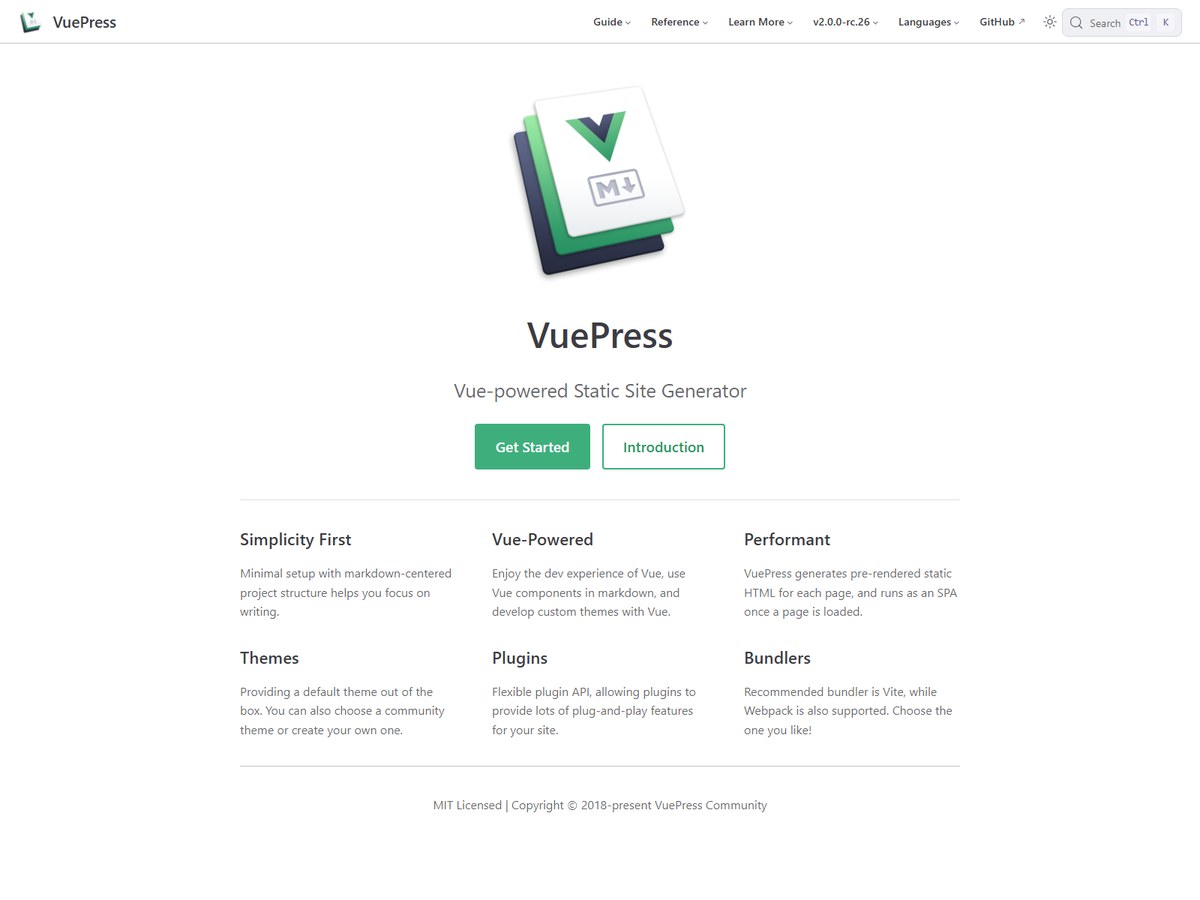
VuePress has 22,717 GitHub stars on its original repository and is a minimalistic, Vue-powered static site generator. It was created by Evan You, who also created Vue. VuePress generates pre-rendered static HTML for each page and then runs as a single-page app once a page loads. You can use Vue components inside Markdown and build custom themes with Vue, and it offers a default theme, plugins, and a choice of bundlers, with Vite recommended and Webpack also supported. Be aware of its status: the README says VuePress v1 is now in maintenance mode. VuePress v2 and later are community supported and built on Vue 3, while the Vue.js team now supports VitePress as its next-generation static site generator. VuePress is open source under the MIT license.

Best forVue developers maintaining an existing VuePress site
Skip it ifYou are starting a new Vue docs site; VitePress is the official pick

Source: github.com/vuejs/vuepress

8
MkDocs by MkDocs open-source project
Image: MkDocs (official site)

MkDocs

MkDocs open-source project · Python static site generator for project documentation

22,554 GitHub stars

Simple, Markdown-first docs for Python teams.

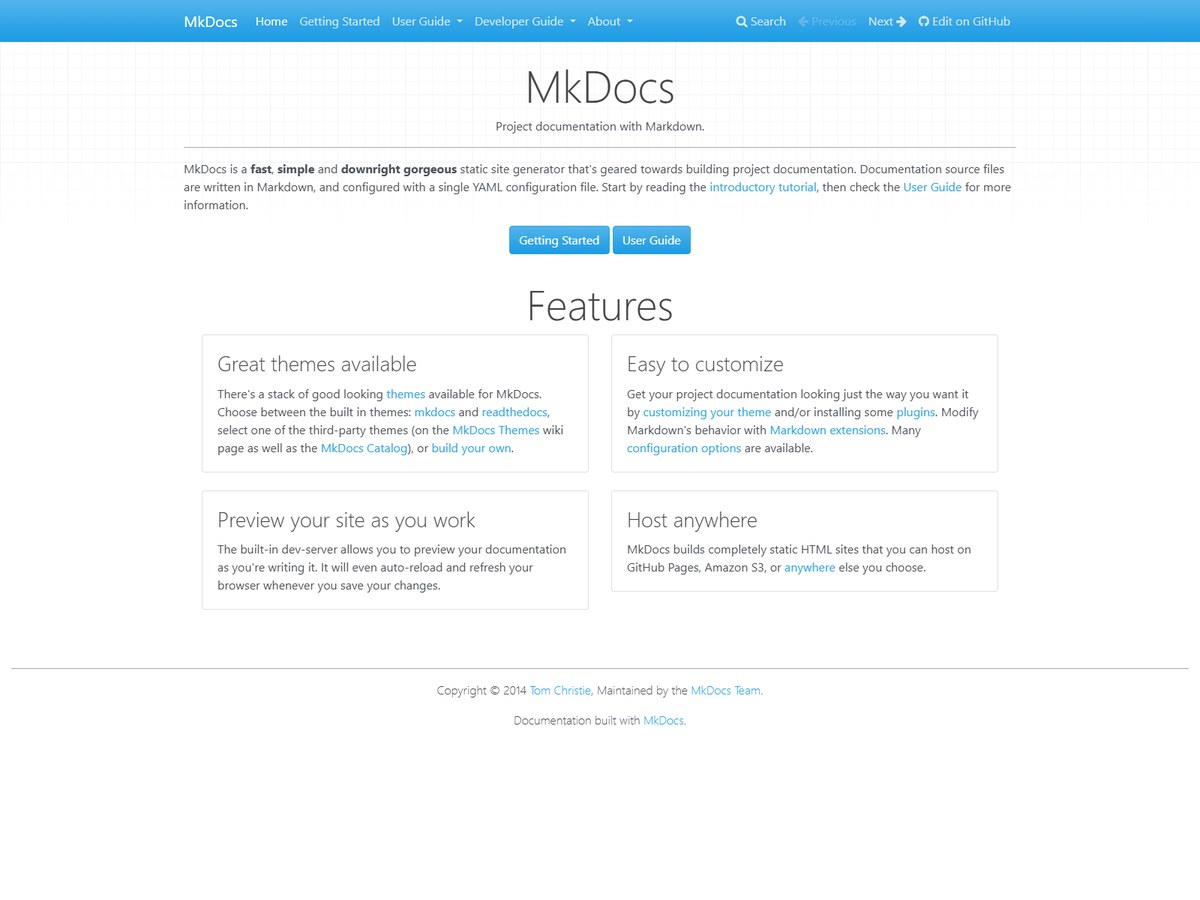
MkDocs has 22,554 GitHub stars and is geared toward one thing: project documentation. Its README describes it as a fast, simple and downright gorgeous static site generator. Documentation source files are written in Markdown and configured with a single YAML configuration file, which keeps setup light. You can extend it with third-party themes, plugins and Markdown extensions, or create your own theme, and it ships with built-in themes. A built-in dev server lets you preview your documentation as you work and reloads whenever you save. The output is plain static HTML that you can publish anywhere static files can be served, including GitHub Pages and Amazon S3. Because it is a Python tool, it is a natural fit for Python projects. MkDocs is open source under the BSD 2-Clause license.

Best forPython teams writing project documentation in Markdown
Skip it ifYou need a blog-first or marketing website

Source: github.com/mkdocs/mkdocs

9
Eleventy by 11ty (Build Awesome)
Image: Eleventy (official site)

Eleventy

11ty (Build Awesome) · Simpler static site generator written in JavaScript

20,042 GitHub stars

The minimalist choice for clean HTML.

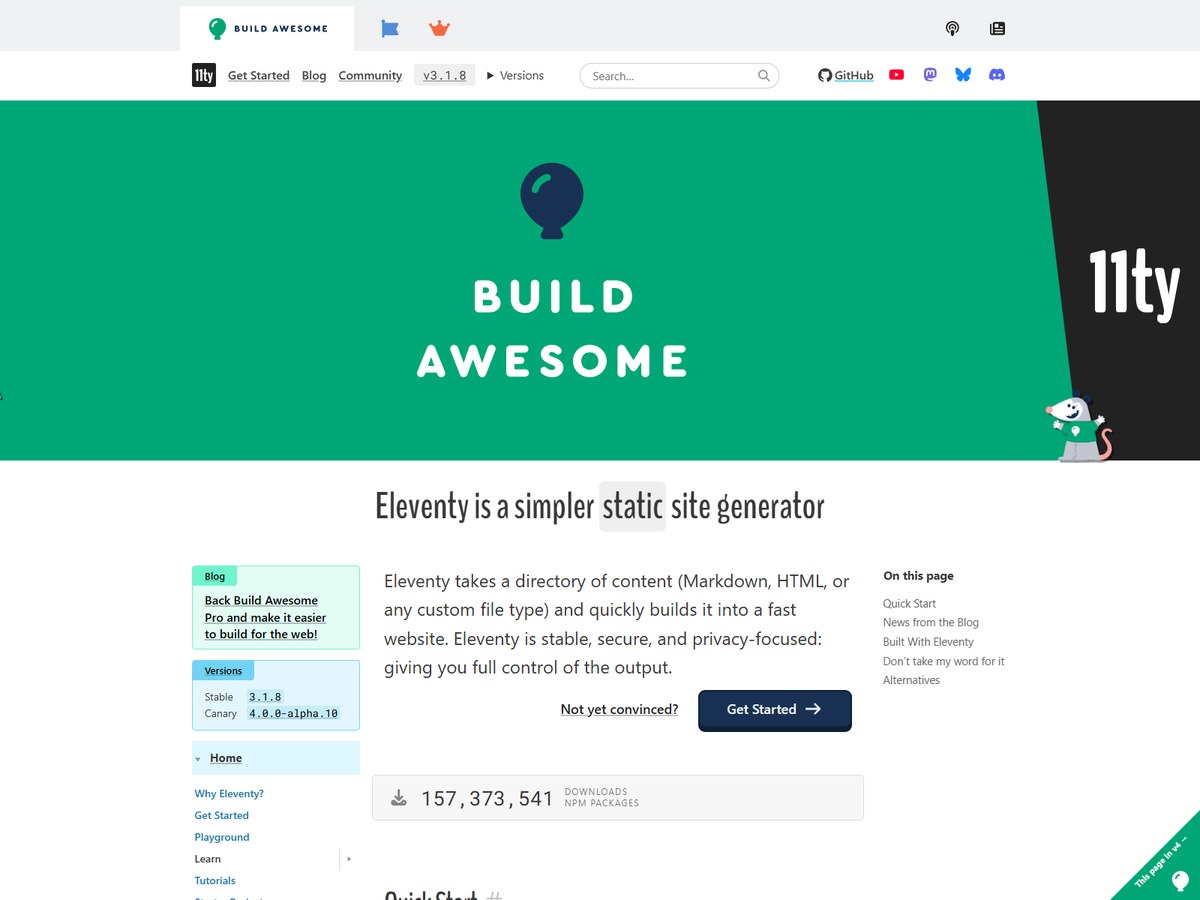
Eleventy has 20,042 GitHub stars and describes itself as "a simpler static site generator" and an alternative to Jekyll, written in JavaScript. It takes a directory of content, such as Markdown, HTML or any custom file type, and quickly builds it into a fast website. Eleventy works with HTML, Markdown, JavaScript, Liquid and Nunjucks, with addons for WebC, Sass, Vue, Svelte, TypeScript, JSX and many others, so you can mix template languages in one project. Its homepage says Eleventy is stable, secure and privacy-focused, giving you full control of the output. The project now sits under the Build Awesome name, alongside Font Awesome and Web Awesome, and its repository is titled Build Awesome (Eleventy). Version 3 is the stable release, with version 4 in pre-release. Eleventy is MIT licensed.

Best forDevelopers who want full control of plain HTML output with little JavaScript
Skip it ifYou want a component framework like React or Vue

Source: github.com/11ty/eleventy

10
VitePress by VitePress (Vue.js team)
Image: VitePress (official site)

VitePress

VitePress (Vue.js team) · Vite and Vue powered static site generator

18,494 GitHub stars

The modern pick for Vue documentation.

VitePress has 18,494 GitHub stars and is the Vue team's modern take on documentation sites. Its README calls it a Vue-powered static site generator and a spiritual successor to VuePress, built on top of Vite. The homepage promise is "Markdown to beautiful docs in minutes": you write in Markdown and VitePress handles the rest. Because it is built on Vite, you get instant server start, lightning-fast hot updates and access to Vite ecosystem plugins. You can use Vue syntax and components directly in Markdown, or build custom themes with Vue. Sites ship with fast initial loads from static HTML and fast navigation from client-side routing. Algolia powers its DocSearch integration. VitePress is MIT licensed and created by Evan You, with version 2.0 in alpha and 1.6.4 as the stable release.

Best forVue developers starting a new documentation site
Skip it ifYou need a full blog or marketing-site toolkit

Source: github.com/vuejs/vitepress

Questions people ask

What is the best static site generator?

Hugo is the most-starred, with 90,476 GitHub stars, and is known for speed. Docusaurus (66,746 stars) is best for documentation, and Astro (63,968 stars) is a strong pick for fast marketing sites and blogs.

What is a static site generator?

A static site generator turns content such as Markdown files and templates into plain HTML files ahead of time. The result loads fast, is hard to hack because there is no database, and can be hosted cheaply almost anywhere.

Which static site generator is best for documentation?

Docusaurus adds document versioning and translations, MkDocs builds docs from Markdown with one YAML file, and VitePress turns Markdown into docs with Vue and Vite.

Which static site generator works with GitHub Pages?

Jekyll is the engine behind GitHub Pages, so you can host a Jekyll site for free straight from a GitHub repository. Hexo also deploys to GitHub Pages with one command.

How were these static site generators ranked?

By GitHub stars on each project's official repository, read November 15, 2026.

How we ranked

GitHub stars on each project's official repository, read November 15, 2026. Stars measure developer interest, not how many live sites use each tool, so treat them as a guide to popularity. Every number on this page comes from the source linked under each pick, and every photo shows the actual product. Brands can't pay to be on this list.

List source: github.com/gohugoio/hugo · Updated 2026-11-15