consumertop10

Home › Software

Top 10 · Software

Top 10 Vector Databases

The databases developers use to store embeddings and power semantic search and RAG, ranked by GitHub stars.

Quick answer

Qdrant is the most popular open-source vector database, with 35,570 GitHub stars: a Rust vector search engine built for fast search with rich filtering. Chroma is second with 29,691 stars and is the easiest to start with, and pgvector is third with 23,686 stars for adding vector search to PostgreSQL. Weaviate, Alibaba's new Zvec and LanceDB follow.

How it's ranked: GitHub stars on each project's official repository, read November 15, 2026. Stars measure developer interest, not paying customers or production use, so treat them as a guide to popularity. Milvus was left out because its official site refused our plain request.

1
Qdrant by Qdrant
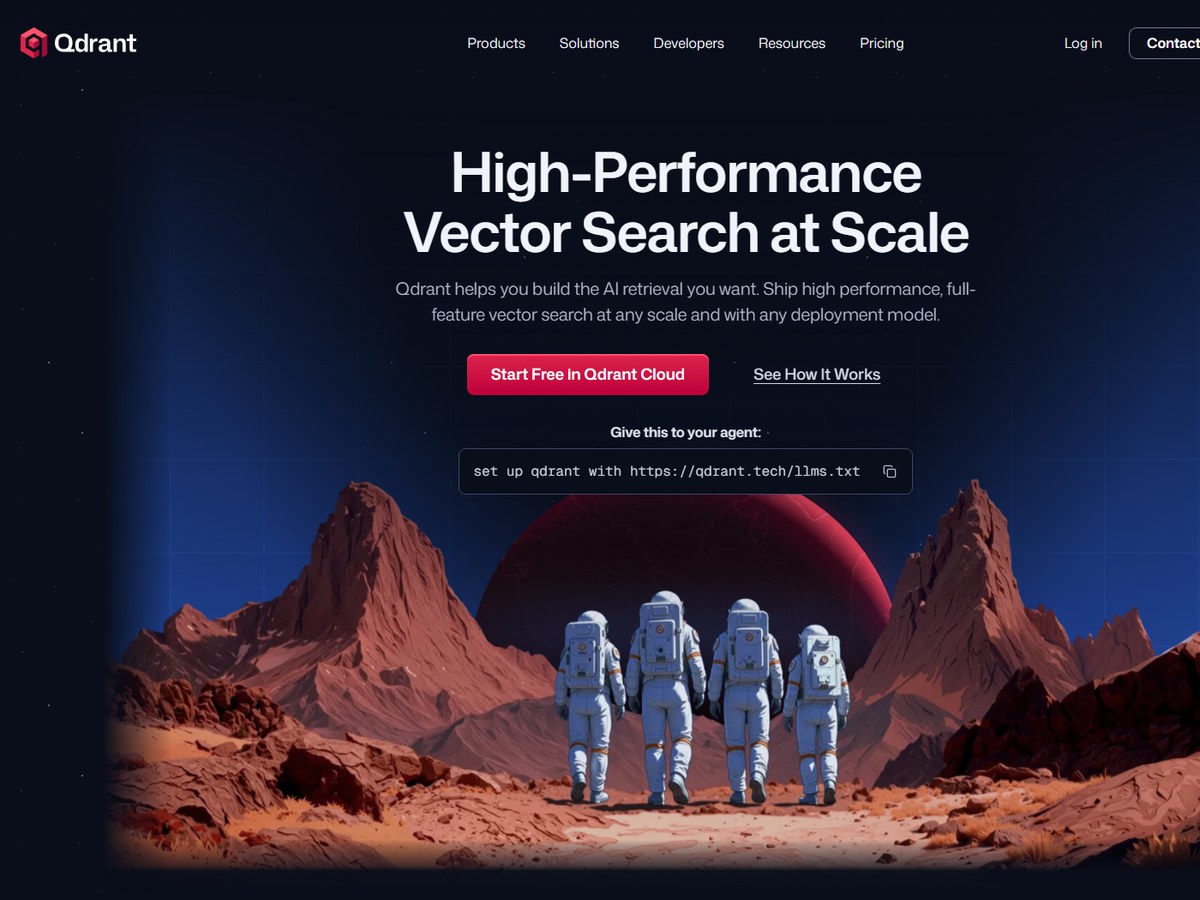
Image: Qdrant (official site)

Qdrant

Qdrant · Vector database and vector search engine written in Rust

35,570 GitHub stars

The most popular dedicated vector database.

Qdrant is the most-starred open-source vector database on this list, with 35,570 GitHub stars. Its README calls it "a vector similarity search engine and vector database" that stores points, which are vectors with an extra payload of data, behind a convenient API. Qdrant is built for extended filtering, so it suits semantic matching, faceted search and recommendations. It is written in Rust, which the project says keeps it fast and reliable even under high load. Official clients cover Go, Rust, JavaScript/TypeScript, Python, .NET/C# and Java. There is also Qdrant Edge, a lightweight version that runs inside your application on edge devices, and a fully managed Qdrant Cloud with a free tier. The code is open source under Apache 2.0.

Best forTeams that need fast vector search with rich filtering in production
Skip it ifYou want vectors inside the database you already run

Source: github.com/qdrant/qdrant
2
Chroma by Chroma
Image: Chroma (official site)

Chroma

Chroma · Open-source search infrastructure for AI

29,691 GitHub stars

The easiest vector store to start with.

Chroma has 29,691 GitHub stars and describes itself as open-source search infrastructure for AI. It supports vector, full-text, regex and metadata search, plus sparse vector search with BM25 and SPLADE. Chroma says it is trusted by millions of developers and counts 15M+ monthly downloads. Its core API is only 4 functions, which is a big part of its appeal for prototypes and AI apps. The hosted Chroma Cloud is serverless, built on object storage, and Chroma says it is up to 10x cheaper with no engineering ops; you can create a database in under 30 seconds with $5 of free credits. It is SOC 2 Type II and open source under Apache 2.0. Chroma's homepage also announces that Chroma is joining Replit.

Best forDevelopers building AI apps who want the simplest start
Skip it ifYou need to self-host a large distributed cluster

Source: github.com/chroma-core/chroma

3
pgvector by pgvector open-source project
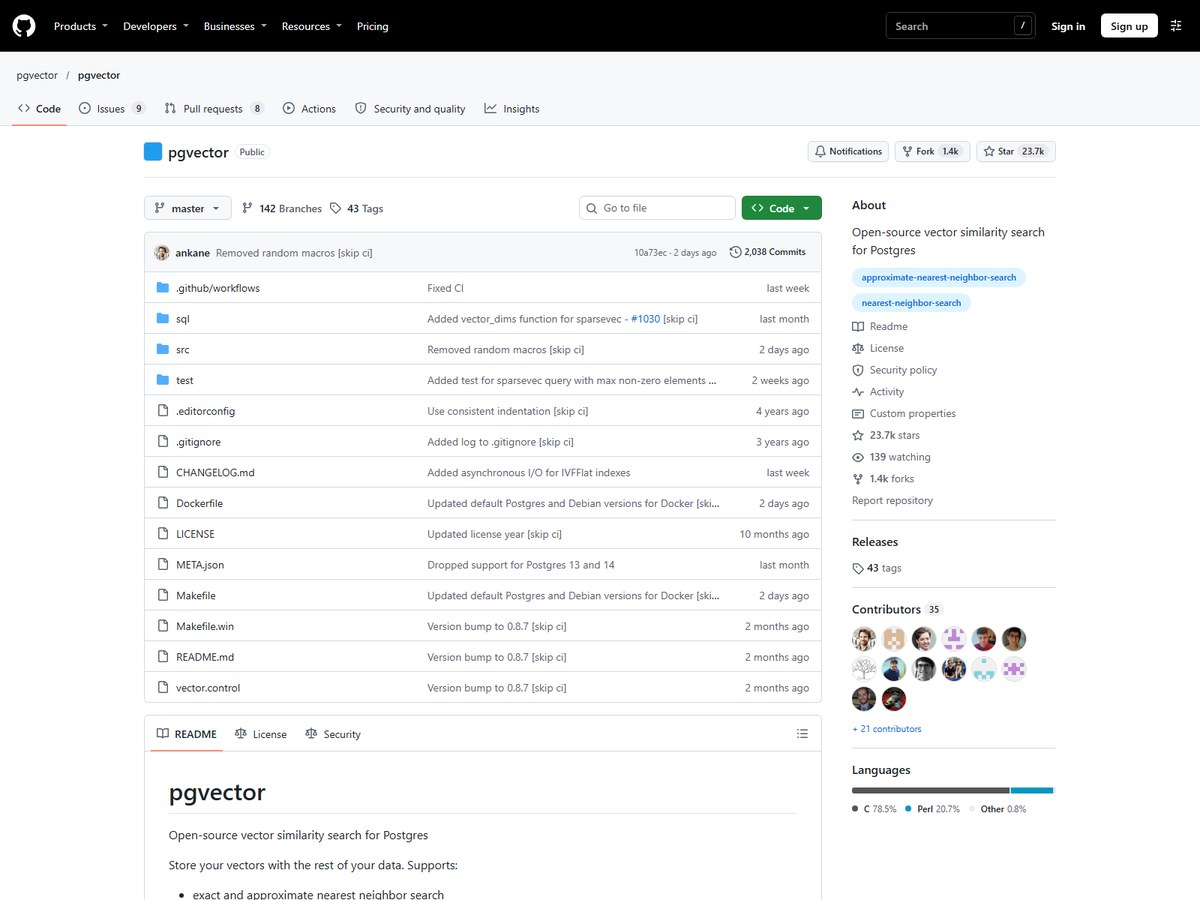
Image: pgvector (official GitHub repository)

pgvector

pgvector open-source project · Vector similarity search extension for Postgres

23,686 GitHub stars

The best choice if you already use Postgres.

pgvector brings vector search to Postgres, and with 23,686 GitHub stars it is the most popular way to add vectors to a database you already run. Its pitch is simple: "Store your vectors with the rest of your data." It supports exact and approximate nearest neighbor search; single-precision, half-precision, binary and sparse vectors; and L2, inner product, cosine, L1, Hamming and Jaccard distance. Because it is a Postgres extension, you keep ACID compliance, point-in-time recovery, JOINs and the rest of Postgres, and you can use it from any language with a Postgres client. It supports Postgres 13+, installs with Docker, Homebrew, APT, Yum and more, and comes preinstalled with Postgres.app and many hosted providers. It is free and open source.

Best forTeams already running PostgreSQL
Skip it ifYou want a separate, purpose-built vector service

Source: github.com/pgvector/pgvector

4
Weaviate by Weaviate
Image: Weaviate (official site)

Weaviate

Weaviate · Cloud-native vector database with built-in vectorization

16,948 GitHub stars

The most complete package for RAG apps.

Weaviate is a cloud-native vector database with 16,948 GitHub stars. It stores both objects and vectors and combines vector similarity search with keyword filtering, retrieval-augmented generation (RAG) and reranking in a single query interface. A standout feature is automatic vectorization: Weaviate can create embeddings at import time with integrated models from OpenAI, Cohere, HuggingFace, Google and others, or you can bring your own. It says it can search billions of vectors in milliseconds and is built in Go. Production features include multi-tenancy, replication and RBAC authorization, and it offers REST, gRPC and GraphQL APIs with clients for Python, JavaScript/TypeScript, Java, Go and C#. Most of the code is BSD 3-Clause, while enterprise features need a commercial license key.

Best forTeams building RAG and semantic search who want embeddings handled for them
Skip it ifYou need every feature under a single open-source license

Source: github.com/weaviate/weaviate

5
Zvec by Alibaba Group
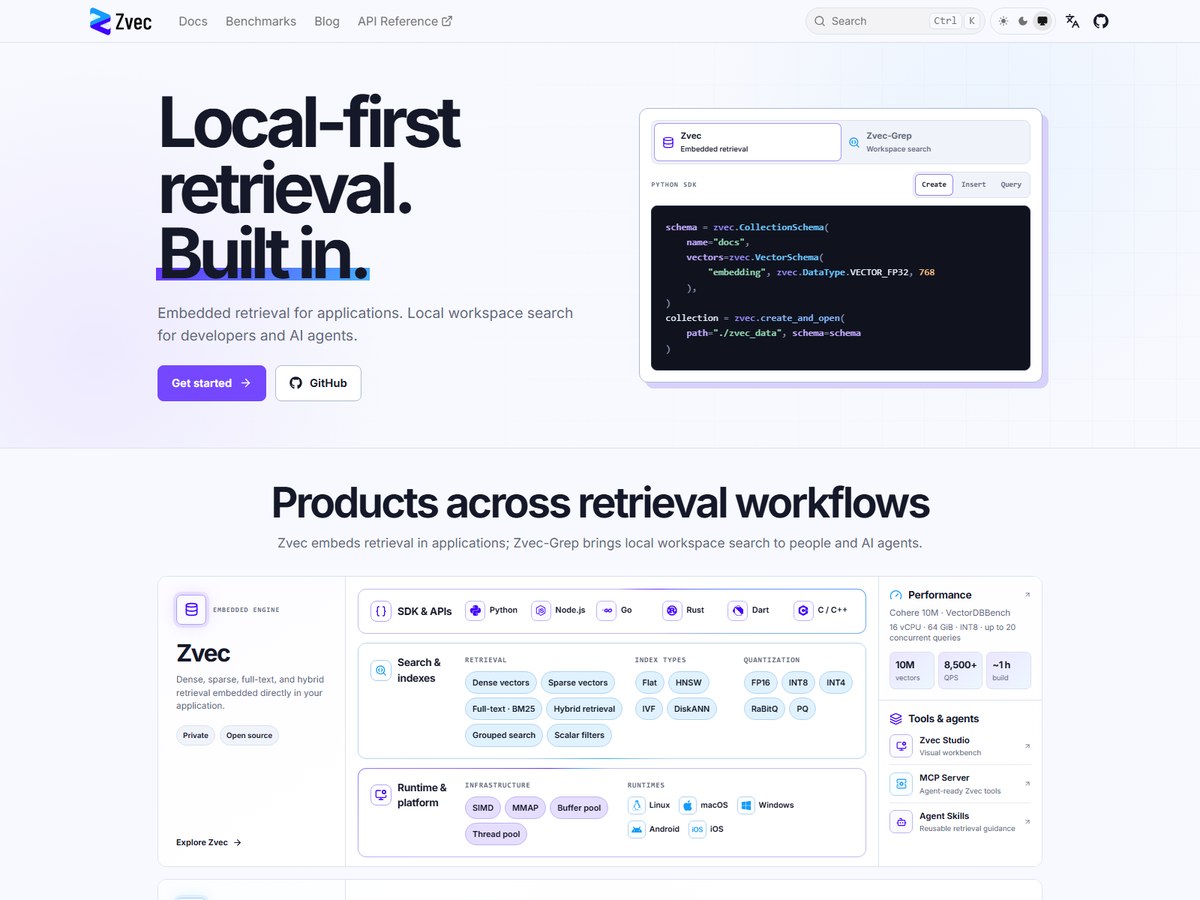
Image: Zvec (official site)

Zvec

Alibaba Group · Lightweight in-process vector database

16,244 GitHub stars

The SQLite-style pick for embedded vector search.

Zvec is a newer arrival from Alibaba Group, and it already has 16,244 GitHub stars. Its README describes it as an open-source, in-process vector database that is lightweight, lightning-fast and designed to embed directly into applications. That means no servers and no config: you install it and start searching in seconds, much as you would with SQLite. Zvec says it was battle-tested within Alibaba Group and can search billions of vectors in milliseconds. It supports dense and sparse embeddings, multi-vector queries, native full-text search and hybrid search that fuses vector, text and structured filters. Version 0.8.0 added Intel Mac and Windows ARM64 builds. It installs with pip install zvec on 64-bit Python 3.10 to 3.14, and it is open source under Apache 2.0.

Best forDevelopers who want vector search embedded in an app with no server
Skip it ifYou need a shared database that many services connect to

Source: github.com/alibaba/zvec

6
LanceDB by LanceDB
Image: LanceDB (official site)

LanceDB

LanceDB · Multimodal lakehouse and embedded vector database

11,906 GitHub stars

Best for multimodal AI data.

LanceDB has 11,906 GitHub stars and calls itself "the multimodal lakehouse for AI." It is built on the Lance columnar format and is designed to store, index and search petabytes of multimodal data and vectors. LanceDB says it can search billions of vectors in milliseconds, and it supports vector similarity search, full-text search and SQL in one place. It can store and filter text, images, videos, point clouds and more next to their vectors, with zero-copy automatic versioning so you can manage versions of your data without extra infrastructure. The open-source LanceDB Embedded runs inside your application's process, with data on local disk or in object storage, while LanceDB Enterprise adds distributed search and indexing. It has Python, Node.js, Rust and REST APIs and is Apache 2.0.

Best forAI teams storing images, video and other multimodal data alongside vectors
Skip it ifYou only need a small key-value vector cache

Source: github.com/lancedb/lancedb

7
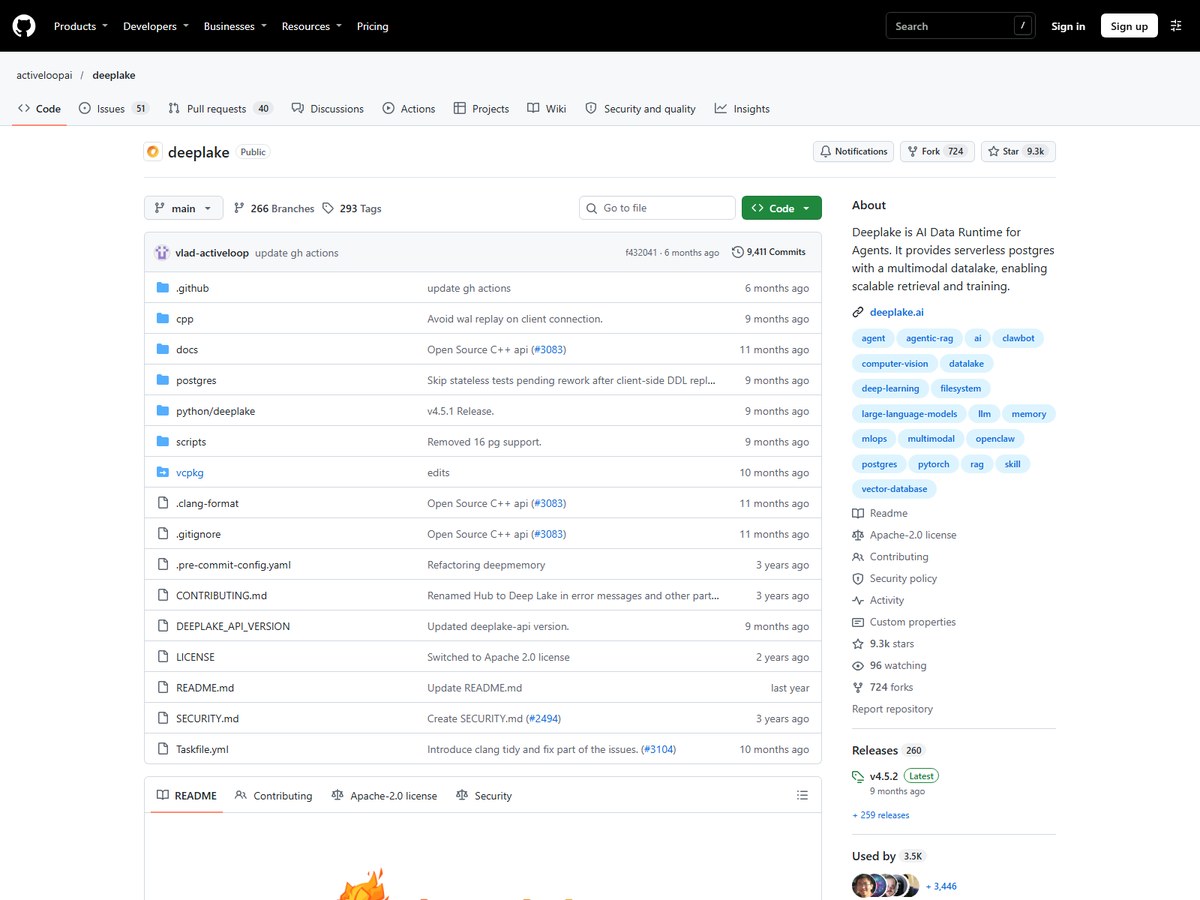
Deep Lake by Activeloop
Image: Deep Lake (official GitHub repository)

Deep Lake

Activeloop · Database for AI built on a deep-learning storage format

9,270 GitHub stars

Vector search and model training in one store.

Deep Lake, from Activeloop, has 9,270 GitHub stars and describes itself as a database for AI powered by a storage format optimized for deep-learning applications. It does two jobs: storing and searching data plus vectors while you build LLM applications, and managing datasets while you train deep learning models. It handles embeddings, audio, text, video, images, DICOM, PDFs and annotations, with vector search, data versioning and lineage, and data streaming while training. Deep Lake is serverless and lets you keep your data in your own cloud, with one API for S3, Azure, GCP, any S3-compatible storage such as MinIO, or local storage. It integrates with LangChain, LlamaIndex and Weights & Biases, and its README names users including Intel, Bayer Radiology, Matterport, Red Cross, Yale and Oxford. It is Apache 2.0.

Best forTeams that both search embeddings and train deep learning models on the same data
Skip it ifYou just need a simple vector search service

Source: github.com/activeloopai/deeplake

8
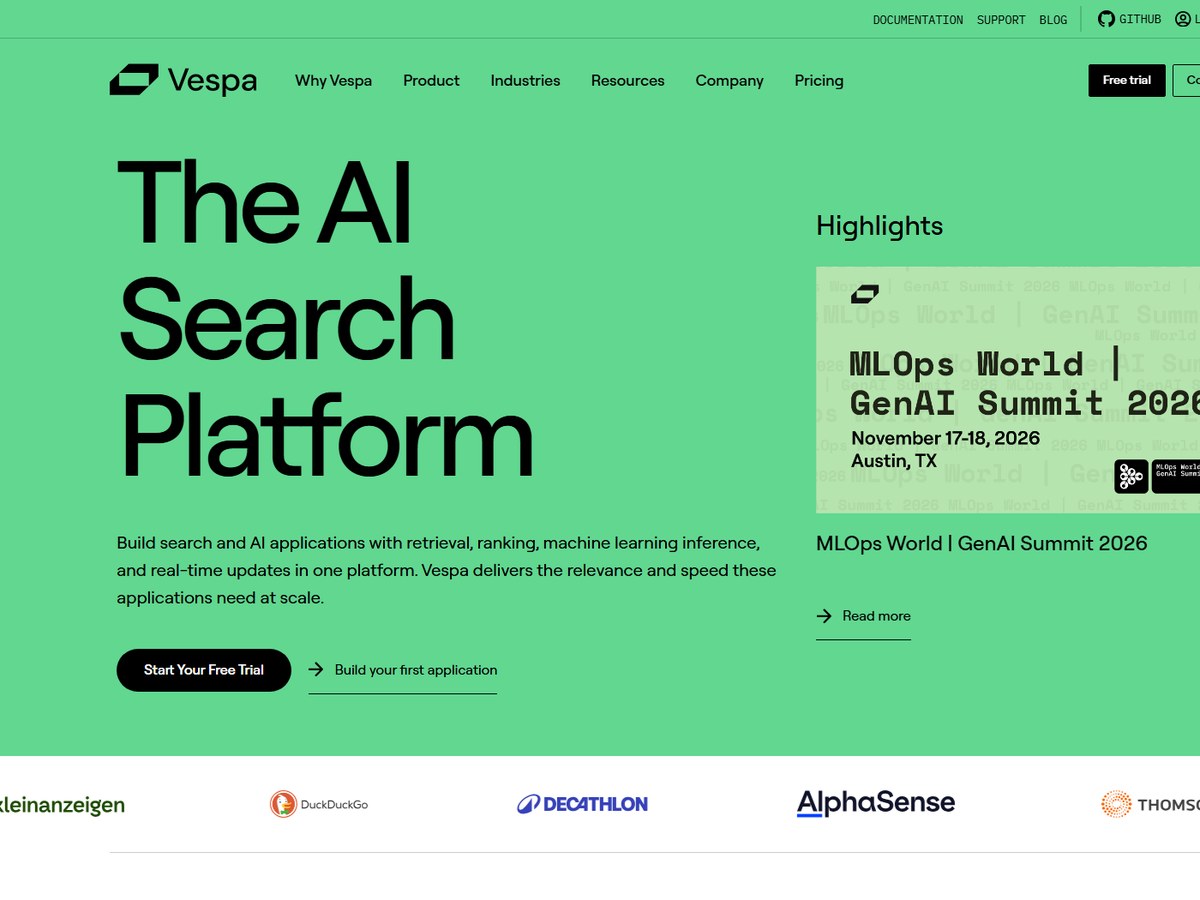
Vespa by Vespa.ai
Image: Vespa (official site)

Vespa

Vespa.ai · AI search platform for vectors, tensors, text and structured data

7,180 GitHub stars

The heavyweight for search and ranking at scale.

Vespa has 7,180 GitHub stars and calls itself "the AI search platform." It goes well beyond storing vectors: Vespa lets you search, make inferences in and organize vectors, tensors, text and structured data at serving time and at any scale. Its README explains the use case: search, recommendation and personalization systems that must pick a subset of a large, constantly changing corpus, run machine-learned models over it and return results, typically in less than 100 milliseconds. Vespa handles the distribution across many nodes with high availability. It has been in development for many years and is used on several large internet services that serve hundreds of thousands of queries per second. A new release ships from the master branch every morning, Monday through Thursday. It is Apache 2.0, with a cloud service and free trial.

Best forLarge services that need search, ranking and recommendations at serving time
Skip it ifYou want a lightweight store for a small RAG prototype

Source: github.com/vespa-engine/vespa

9
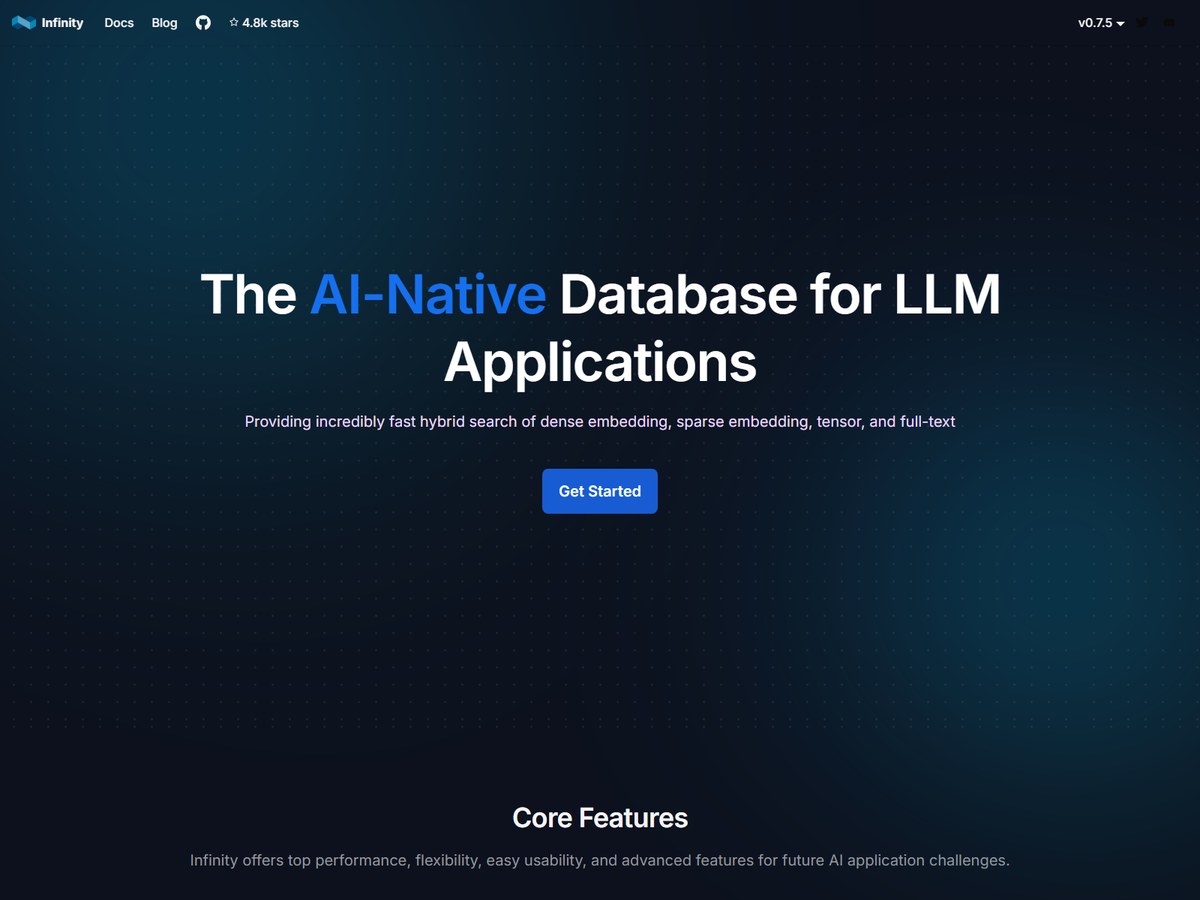
Infinity by InfiniFlow
Image: Infinity (official site)

Infinity

InfiniFlow · AI-native database for LLM applications

4,765 GitHub stars

Hybrid search built for RAG.

Infinity, from InfiniFlow, is an AI-native database built for LLM applications, with 4,765 GitHub stars. It offers hybrid search across dense vectors, sparse vectors, tensors (multi-vector), full text and structured data, plus filtering, and supports rerankers including RRF, weighted sum and ColBERT. That mix makes it a fit for search, recommenders, question answering, conversational AI, copilots and other retrieval-augmented generation apps. Infinity publishes bold performance numbers: 0.1 milliseconds query latency and 15K+ QPS on million-scale vector datasets, and 1 millisecond latency with 12K+ QPS in full-text search on 33M documents. It is a single binary with no dependencies, has an intuitive Python API and can be embedded in Python as a module. It is open source under Apache 2.0.

Best forRAG builders who want dense, sparse, tensor and full-text search in one engine
Skip it ifYou want a large ecosystem and long track record

Source: github.com/infiniflow/infinity

10
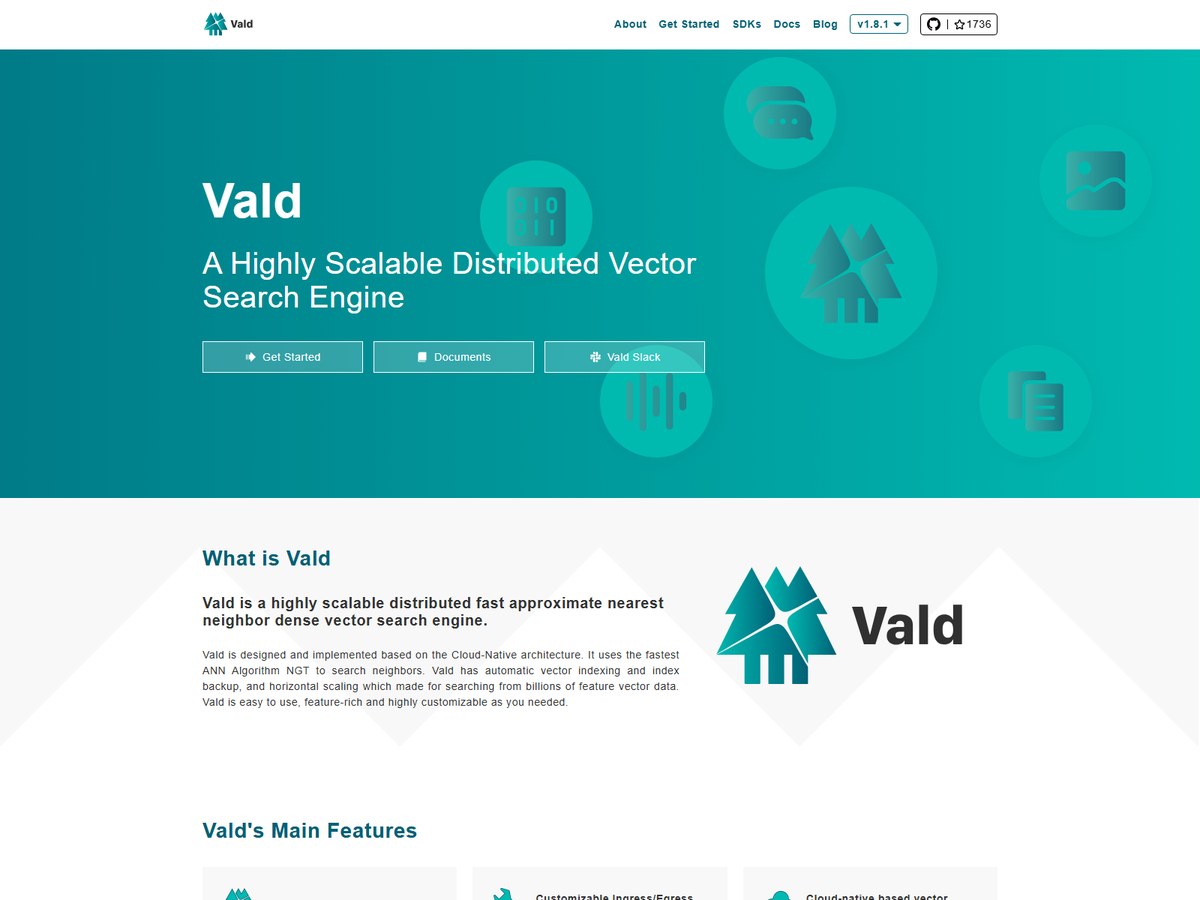
Vald by Vald project (vdaas)
Image: Vald (official site)

Vald

Vald project (vdaas) · Distributed approximate nearest neighbor vector search engine

1,736 GitHub stars

Cloud-native vector search for Kubernetes shops.

Vald rounds out the list with 1,736 GitHub stars. It is a highly scalable, distributed, fast approximate nearest neighbor (ANN) dense vector search engine, designed from the start on a cloud-native architecture. Vald provides automatic vector indexing and index backup, plus horizontal scaling built for searching billions of feature vectors. It uses NGT, which the project calls the fastest ANN algorithm, to search for neighbors. Vald can handle any data that can be turned into a vector, including images, audio, video and text, for jobs such as recognition, recommendation, detection and real-time translation. It runs on Kubernetes 1.19 or later, installs with Helm, and needs CPUs with AVX2 instructions. Vald is open source under the Apache 2.0 license.

Best forKubernetes teams searching billions of vectors
Skip it ifYou do not run Kubernetes

Source: github.com/vdaas/vald

Questions people ask

What is the best vector database?

Qdrant is the most-starred dedicated vector database on GitHub, with 35,570 stars. Chroma, with 29,691 stars, is the easiest to start with, and pgvector, with 23,686 stars, is best if you already run PostgreSQL.

What is a vector database used for?

A vector database stores embeddings, the numeric representations AI models make of text, images and other data, and finds the most similar ones fast. It powers semantic search, recommendations and retrieval-augmented generation (RAG) for chatbots.

Do I need a separate vector database if I use Postgres?

Not always. pgvector adds exact and approximate nearest neighbor search to Postgres, so you can keep vectors with the rest of your data and still use JOINs and ACID transactions.

Which vector databases run inside my application?

Zvec is an in-process vector database with no servers or config, LanceDB Embedded runs in your application process, and Infinity can be embedded in Python as a module.

How were these vector databases ranked?

By GitHub stars on each project's official repository, read November 15, 2026.

How we ranked

GitHub stars on each project's official repository, read November 15, 2026. Stars measure developer interest, not paying customers or production use, so treat them as a guide to popularity. Milvus was left out because its official site refused our plain request. Every number on this page comes from the source linked under each pick, and every photo shows the actual product. Brands can't pay to be on this list.

List source: github.com/qdrant/qdrant · Updated 2026-11-15